What needed solving
Human operators frequently misread characters, especially on damaged, faded, or partially obscured packaging. The manual process introduced an unacceptable error rate that compromised data reliability.
Field volunteers captured images under uncontrolled conditions — varying angles, orientations, lighting, backgrounds, and distances. Packets appeared tilted, rotated, partially cropped, or occluded in many images.
How Qualitas solved it
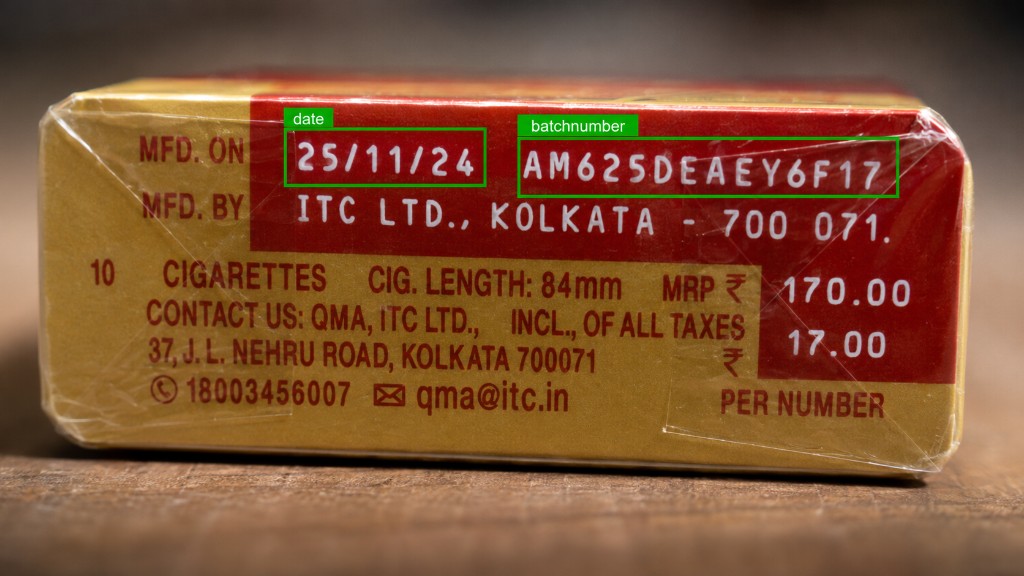
The first stage of the pipeline uses a YOLO-based object detection model trained to identify and localize the date and serial number text regions on cigarette packets.
Once the text regions are localized, the cropped image patches are processed by a PaddleOCR model fine-tuned for this domain. The OCR model reads the characters within each detected region and outputs the date code and serial number as structured text.
Abstract
Designed and deployed a web-based AI solution combining YOLO object detection with PaddleOCR to automatically extract date codes and serial numbers from cigarette packet images captured under highly variable field conditions — achieving 99.14% accuracy on dates and 95.66% on serial numbers in a 3-month engagement.
Executive Summary
This case study presents the development and deployment of an AI-based automated system for extracting date codes and serial numbers from cigarette packet images. The client, a leading FMCG company, relied on a manual workflow involving field volunteers capturing packet images and data entry operators manually transcribing the information. This process was error-prone, time-consuming, and difficult to scale.
Qualitas Technologies designed and deployed a web-based solution combining YOLO object detection with PaddleOCR to automatically identify and read date and serial number fields from images captured under highly variable real-world conditions. Over a 3-month development period, the system achieved 99.14% accuracy for date extraction and 95.66% accuracy for serial number recognition, dramatically reducing manual errors and processing time.
Client Context
The client is a major player in the FMCG sector with operations spanning multiple regions. As part of their regulatory compliance and supply chain traceability efforts, they needed to capture manufacturing date codes and serial numbers from cigarette packets sold across retail outlets.
The existing workflow involved field volunteers visiting retail stores, photographing cigarette packets, and uploading the images. Back-office data entry operators would then manually read and record the date and serial number from each image. This process introduced significant errors due to human fatigue, inconsistent image quality, and the sheer volume of packets processed daily.
The Challenge
- Manual Data Entry Errors: Human operators frequently misread characters, especially on damaged, faded, or partially obscured packaging. The manual process introduced an unacceptable error rate that compromised data reliability.
- Extreme Image Variability: Field volunteers captured images under uncontrolled conditions — varying angles, orientations, lighting, backgrounds, and distances. Packets appeared tilted, rotated, partially cropped, or occluded in many images.
- Scalability Constraints: The manual approach could not keep pace with the growing volume of field data. Hiring and training additional operators was costly and did not address the root cause of inaccuracy.
- Inconsistent Data Quality: Without standardization, the captured data suffered from formatting inconsistencies, making downstream analysis and compliance reporting unreliable.
Objectives
- Automate the extraction of date codes and serial numbers from cigarette packet images, eliminating manual data entry.
- Handle extreme image variability including arbitrary orientations, angles, lighting conditions, and partial occlusions.
- Achieve production-grade accuracy suitable for regulatory compliance and traceability workflows.
- Deploy as a user-friendly web application accessible to field volunteers and back-office teams.
Our Approach
Qualitas Technologies employed a systematic methodology to develop and deploy the solution. The project followed a structured pipeline from data collection through model training, integration, and deployment.
Implementation
The first stage of the pipeline uses a YOLO-based object detection model trained to identify and localize the date and serial number text regions on cigarette packets. This model was trained on a diverse dataset of real-world images collected from field volunteers, encompassing a wide range of orientations, angles, lighting conditions, and packet designs.
Key design decisions: The detection model was trained to handle arbitrary image orientations, meaning volunteers did not need to align packets in any specific way. The model outputs bounding box coordinates for each detected text region, which are then cropped and passed to the OCR stage.
Once the text regions are localized, the cropped image patches are processed by a PaddleOCR model fine-tuned for this domain. The OCR model reads the characters within each detected region and outputs the date code and serial number as structured text.
Handling orientation challenges: A critical challenge was that images arrived in highly varied orientations — upside down, sideways, at steep angles. The detection model was trained to be rotation-invariant, and detected regions were normalized before being passed to OCR, ensuring consistent recognition regardless of the original image orientation.
The trained models were integrated into a web application designed for ease of use by field volunteers and back-office teams. Volunteers capture or upload images of cigarette packets through a simple browser-based interface. The system processes each image in real time, displaying the extracted date and serial number for quick verification before submission.
Challenges Overcome
This deployment model eliminated the need for specialized hardware or app installations, enabling rapid adoption across the volunteer network.