A robot without vision knows exactly one thing: where it was told to go. It moves to a fixed coordinate, grips, and returns — reliably, endlessly, blindly. That works when every part arrives in the same position, every shift, forever. In real factories, it rarely does. Parts shift on conveyors. Bins arrive randomly loaded. Weld joints migrate by fractions of a millimetre across a batch run. Vision-guided robotics is what closes that gap — giving the robot a real-time picture of what’s actually in front of it, so it can act on what it sees rather than what it was programmed to expect.
Vision-Guided Robotics: Giving Your Robot the Ability to See
What Vision-Guided Robotics Enables
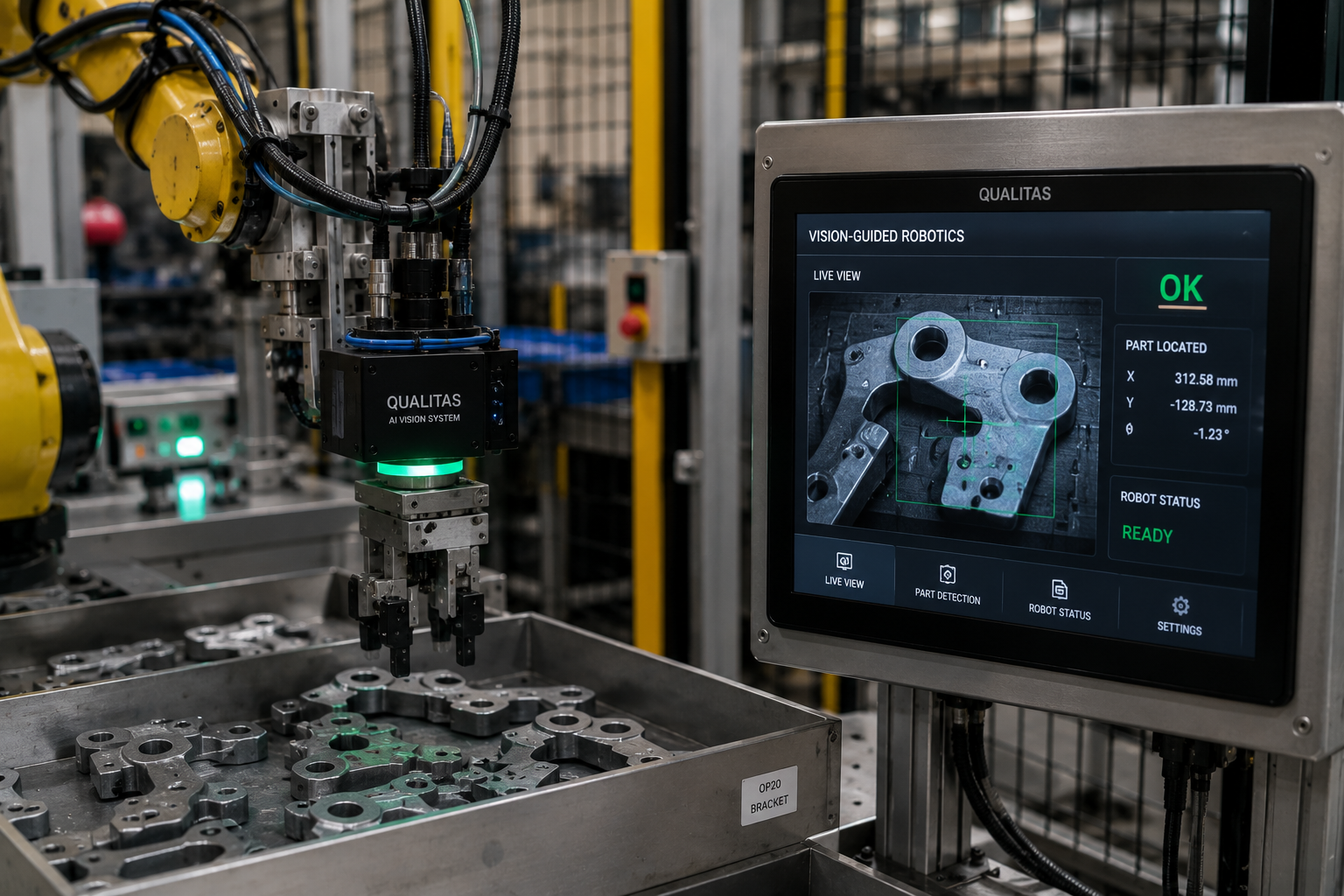
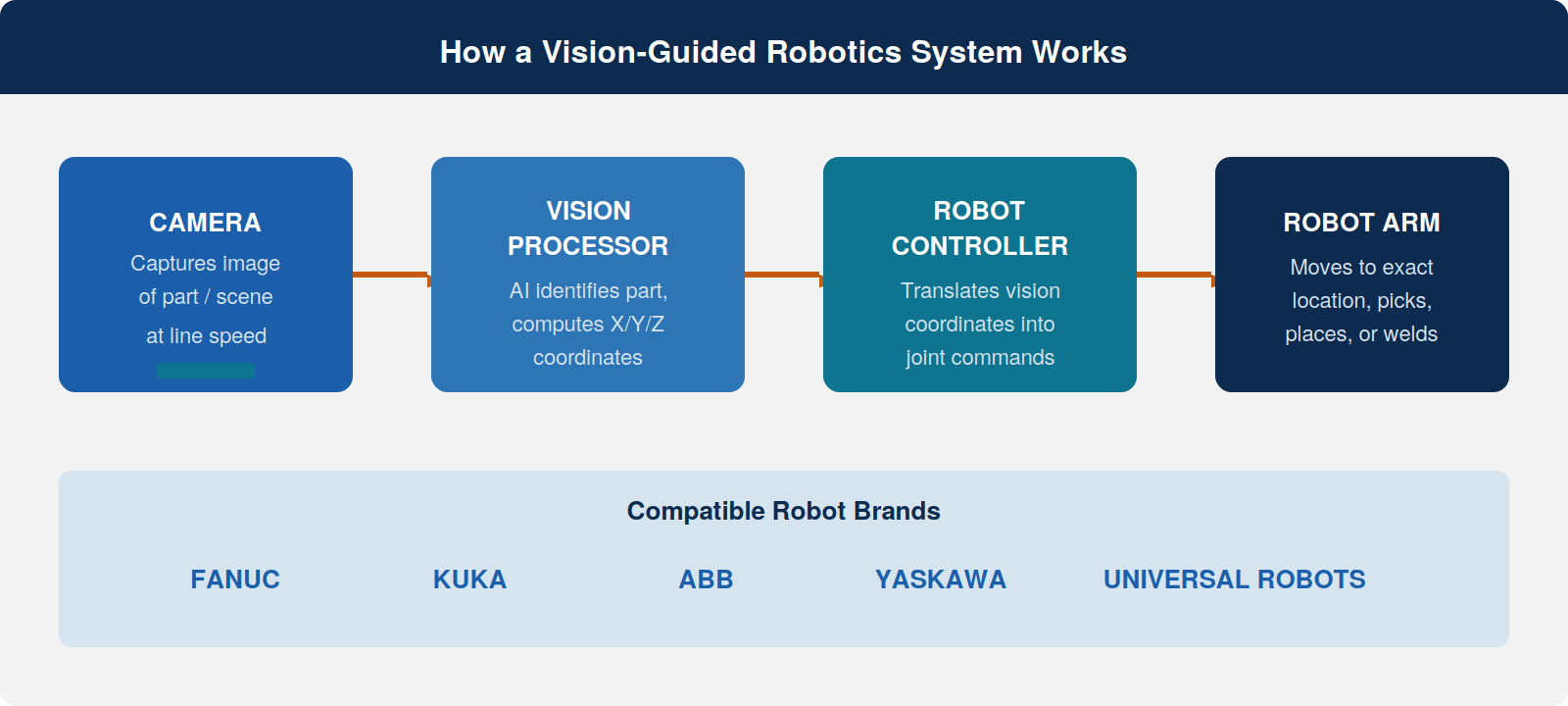
A conventional robot is programmed for a specific part in a specific position. Change the part, or let it drift even a few millimetres, and you get a mis-pick, a jam, or a scrapped component. A robot vision system removes that brittleness. The camera captures the scene, the vision software computes the part’s actual position and orientation, and those coordinates reach the robot controller in real time — typically within 50–150 milliseconds.
This real-time feedback loop unlocks three things that fixed automation cannot deliver:
- Flexibility without retooling. Change a part variant or product size, and only the trained part model changes — not the robot’s mechanical fixtures. Vision replaces hard tooling with software.
- Handling of randomness. Bin picking, conveyor drift, and mixed-orientation pallets become solvable. The robot sees what’s there and adapts accordingly.
- Inspection at the point of action. The same camera that guides the gripper can verify the part’s identity, check for obvious defects, or confirm correct placement before releasing — turning one station into two.
The global market for vision-guided robotics was valued at approximately USD 13.2 billion in 2024 and is projected to reach USD 22.3 billion by 2030, growing at a CAGR of 9.1%. India’s manufacturing sector is a notable contributor to that growth as pharma and engineering component exporters adopt vision-guided systems to meet international quality standards.
Key Applications: Pick & Place, Welding, and Assembly
Vision-guided robotics shows up in different forms depending on the task. The underlying principle is the same — coordinate-to-camera-to-robot — but the camera configuration, lighting, and vision algorithm differ significantly by application.
Pick and Place
This is the highest-volume application. A 2D vision system locates parts on a moving conveyor, calculates their centre and angle, and feeds that data to the robot so it can pick at exactly the right point. Cycle time drops from 15–17 seconds (manual) to 3–4 seconds with vision guidance, as seen in our vision-guided pick-and-place use case for bins on a moving conveyor. When parts arrive randomly across all three axes — such as in bin picking — 3D vision is required to compute the full X/Y/Z orientation.
Welding
Weld joint position varies batch to batch as plates and assemblies shift during clamping. Vision-guided seam tracking allows the robot to adjust its path in real time to the actual joint, not the nominal one. This is critical for automotive structural welds where +/- 0.5 mm deviation affects joint strength.
Assembly Verification
In assembly applications, vision does double duty — guiding the robot to the correct insertion point and then verifying the assembly outcome. A camera mounted end-of-arm or overhead can confirm part presence, correct orientation, and proper seating before the robot moves to the next step. This closes the quality loop without adding a separate inspection station. See how EagleEye® handles this in assembly verification with deep learning.
Robot Brand Compatibility
One of the most common concerns automation engineers raise is whether a vision system will communicate cleanly with an existing robot. In practice, all major robot controllers expose a communication interface — Ethernet/IP, TCP/IP socket, or vendor SDK — through which a vision processor can send coordinates.
At Qualitas, our EagleEye® system interfaces with Fanuc, KUKA, ABB, Yaskawa, and Universal Robots by transmitting the located part’s X, Y, Z coordinates and rotation angle to the robot controller. The robot’s native motion planner handles the rest. The vision side is brand-agnostic; what changes per brand is the communication protocol and register mapping — a one-time configuration step during installation.
| Aspect | Fixed-Program Robot | Vision-Guided Robot |
| Part variation tolerance | None — fails on drift >1–2 mm | Handles full positional variation in real time |
| Product changeover | Mechanical retooling required | Software model swap — minutes, not hours |
| Bin picking capability | Not possible without precise feeders | 3D vision handles full random bin orientation |
| In-process inspection | Separate station needed | Camera does guidance and verification simultaneously |
| Initial cost | Lower hardware cost | Higher upfront; 12–24 month typical ROI |
Integration Steps: How to Add Vision to Your Robot Cell
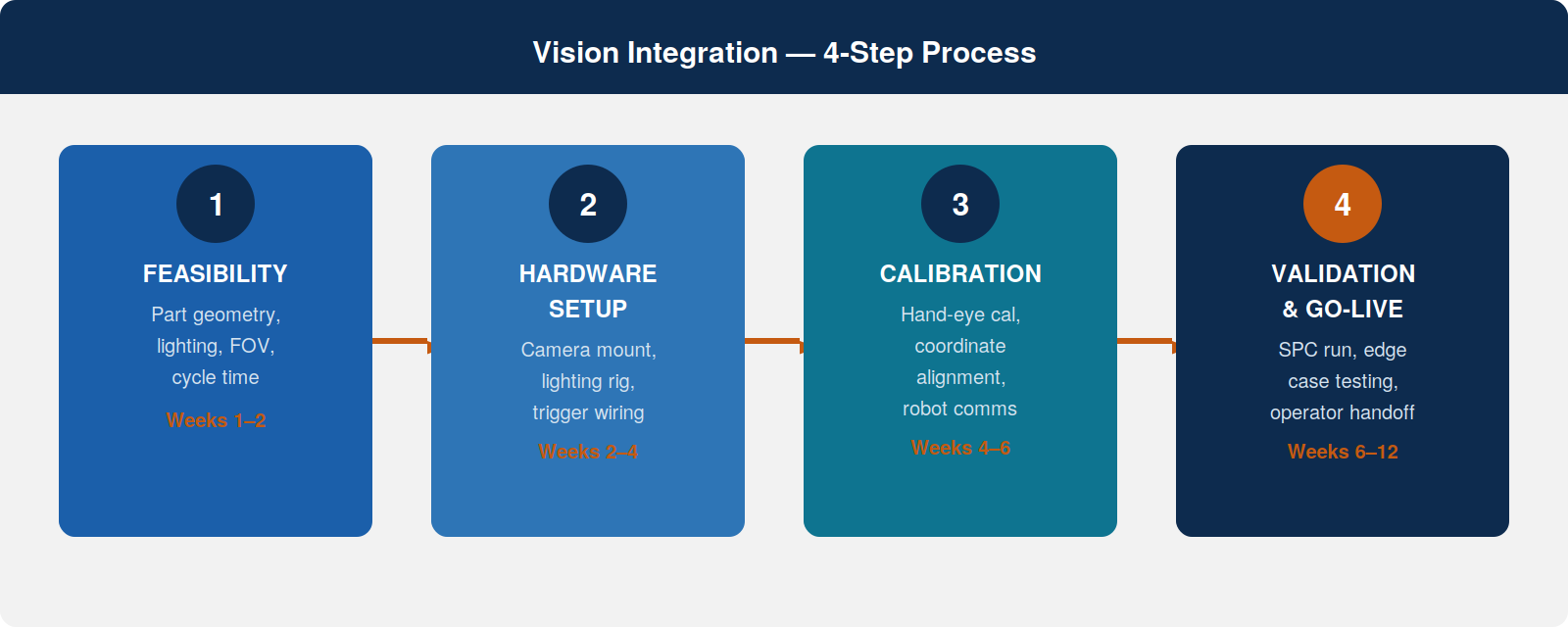
Adding vision to a robot cell isn’t plug-and-play, but it is structured. The four steps below describe what a real integration looks like — and where projects most commonly stumble.
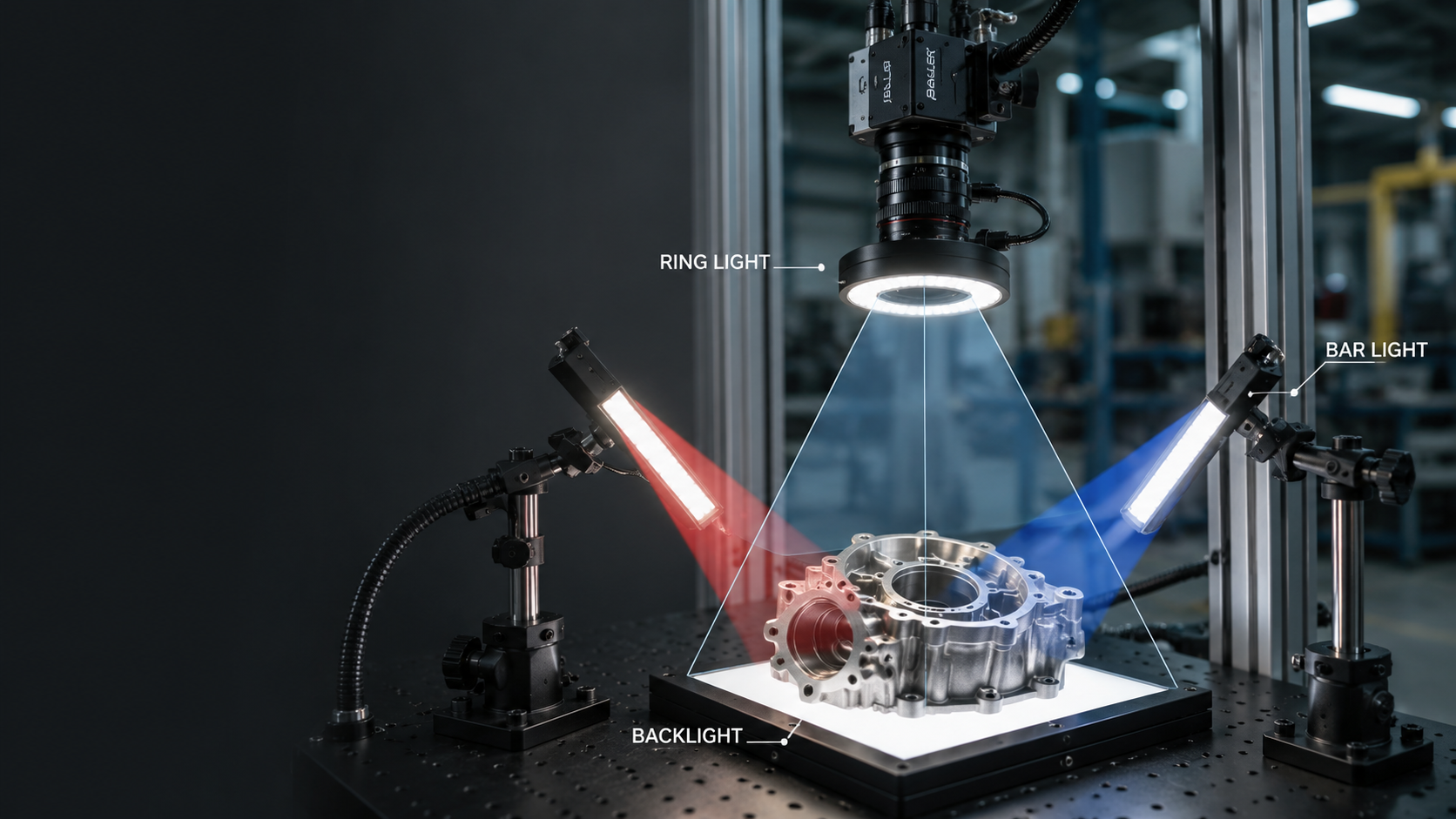
- Step 1 — Feasibility and application scoping. Define the part’s geometry, the required pick accuracy, conveyor speed, and allowable cycle time. Decide whether 2D (flat parts, single plane) or 3D (bin picking, stacking) vision is appropriate. Lighting is chosen here — getting it wrong means restarting from camera selection.
- Step 2 — Hardware installation. Mount the camera in a stable position (overhead, wrist-mounted end-of-arm, or fixed-field). Install the lighting rig. Wire the trigger signal — the robot or PLC tells the camera when to fire, so images are taken at the right moment in the cycle.
- Step 3 — Hand-eye calibration. This is the critical step most engineers underestimate. The vision coordinate system must be aligned to the robot coordinate system so that when the camera says “part at X=320, Y=118 mm”, the robot moves to exactly that point in its own frame. A calibration grid (checkerboard or dot pattern) is used to compute the transformation matrix. Errors here translate directly to pick offsets.
- Step 4 — Validation and go-live. Run a statistical process control (SPC) study across 200–300 picks. Test edge cases: worst-case lighting variation, minimum part contrast, conveyor speed extremes. Once the system holds within spec, hand over to production and document the re-calibration procedure for the maintenance team.
For a real-world example of this process — and the challenges of large field-of-view vision guidance on a moving conveyor — see our robot automation assistance case study.
Typical deployment timeline:
A well-scoped vision-guided pick-and-place integration — from first site visit to production go-live — runs 6–12 weeks. Complex 3D bin-picking or multi-camera welding guidance projects extend to 14–20 weeks.
ROI Data: What the Numbers Say
The ROI case for vision-guided robotics is most compelling in high-labour, multi-shift pick operations. Consider what manual pick-and-place actually costs: two operators per shift, three shifts, with cycle times of 15–17 seconds — versus a vision-guided robot running at 3–4 seconds around the clock with zero fatigue errors. The labour cost differential alone typically drives payback within 12–24 months for well-scoped projects, a finding consistent across multiple Qualitas deployments in plastics, automotive components, and electronics sub-assembly.
Beyond labour, there are three additional ROI drivers that automation engineers often under-count:
- Fixturing cost elimination. Fixed automation requires precision jigs and fixtures for every part variant. Vision replaces that hardware with a software model — a new SKU means a training session, not a toolmaker’s invoice.
- Scrap and rework reduction. Mis-picks that cause surface scratches, misaligned assemblies, or damaged components generate hidden costs that rarely show up in the automation budget but are real on the P&L. Vision guidance eliminates the positional errors that cause them.
- Throughput gain. Consistent cycle times at machine speed — with no operator fatigue curve across a 12-hour shift — increase effective line output. Manufacturers adopting VGR report average ROI achievement in the 12–18 month window for correctly specified applications.
For a structured framework on building the business case for any machine vision system, see what the ROI of a machine vision system looks like. Our EagleEye® robotic guidance solution page covers the technical specifications and robot brand integrations in detail.
Frequently Asked Questions
What is vision-guided robotics?
Vision-guided robotics (VGR) is a system where one or more cameras act as real-time sensors that feed position, orientation, and identity data to a robot controller. Instead of moving to a fixed coordinate, the robot responds to what it actually sees — handling part variation, conveyor drift, and random bin orientation without reprogramming.
Which robot brands work with machine vision systems?
All major brands — Fanuc, KUKA, ABB, Yaskawa, Universal Robots — support external vision integration through standard communication interfaces such as TCP/IP and Ethernet/IP. A well-designed vision system like EagleEye® can be calibrated to any of these controllers during the hand-eye calibration step.
What is the difference between 2D and 3D robot vision?
2D vision locates a part in a single plane — X, Y position and rotation. This covers most flat or fixtured parts on a conveyor. 3D vision adds depth (Z-axis), which is necessary for bin picking, stacking, and applications where parts arrive in random orientations across all three dimensions.
How long does integration take?
A straightforward pick-and-place integration typically takes 6–12 weeks from site visit to go-live. Complex 3D applications or multi-camera setups extend to 14–20 weeks. A structured POC engagement can compress the discovery and feasibility phase before committing to full deployment.
What is the typical ROI timeline?
For high-labour, multi-shift pick applications, payback is typically 12–24 months. The main drivers are labour substitution, elimination of fixturing cost, and scrap reduction from pick errors.
Continue exploring: Read the robot automation assistance case study to see how vision guidance handled large field-of-view picking on a live production conveyor.