A machine vision system doesn’t see a part the way you do. It sees light bouncing off a surface. Get the lighting wrong, and even a great camera and a smart algorithm can’t find a defect sitting right in front of them. Get it right, and a cheap change in lighting can outperform an expensive camera upgrade. This guide covers the handful of lighting setups that cover almost every machine vision job, and how to pick between them.
What Actually Controls How a Part Looks in the Image
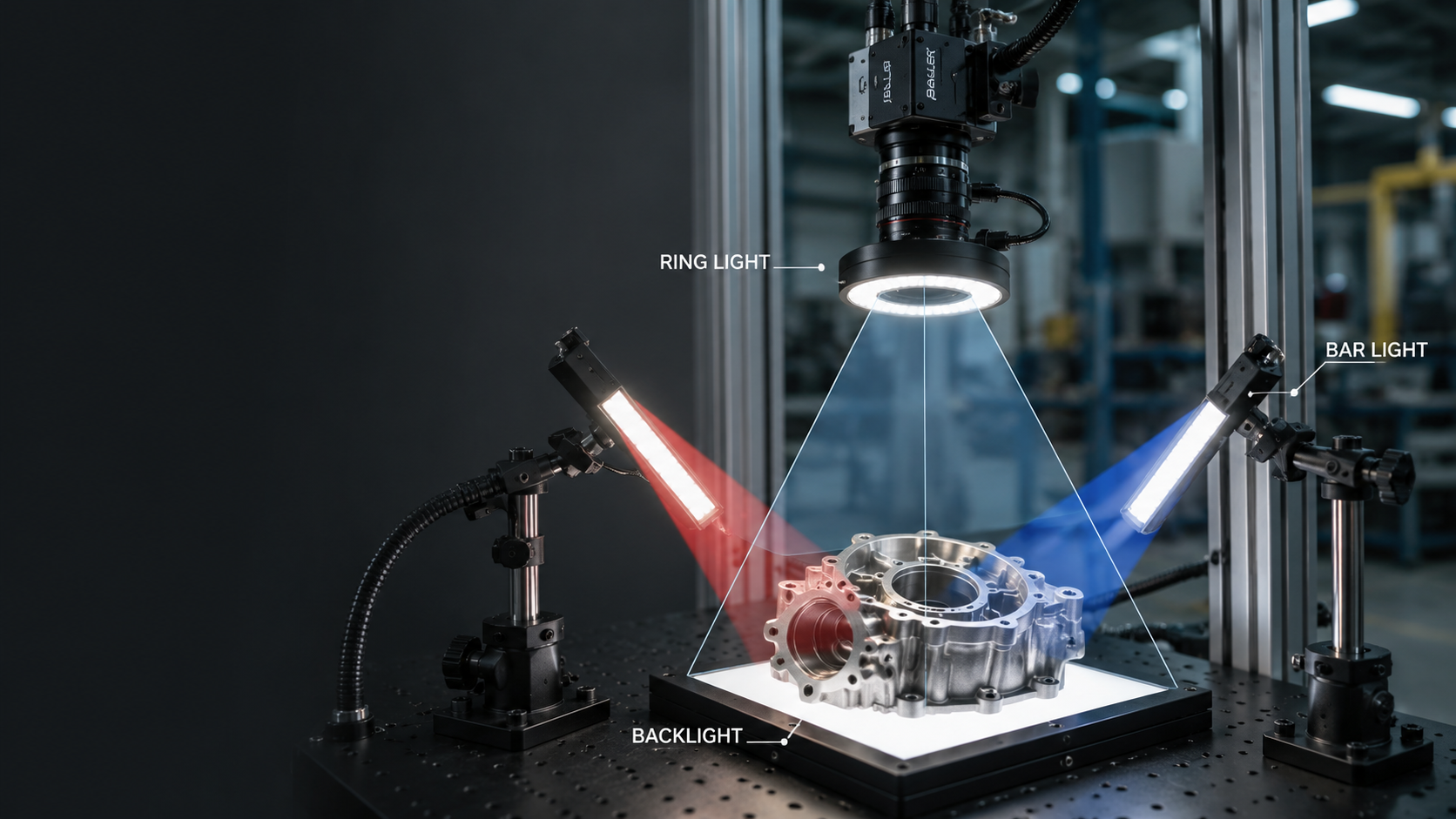
Three choices control how a part looks in an image. Where the light sits, compared to the part and the camera. The shape of the light — a narrow beam, a soft dome, a thin line. And the color of the light. Change any one of these, and a defect that was invisible a minute ago can suddenly stand out clearly.
Six Lighting Setups You’ll Actually Use
Almost every machine vision job is covered by one of these six setups.
| Setup | What It Does | Best For |
|---|---|---|
| Bright-field | Light shines straight onto the part from the front. | Flat parts with an even background. |
| Dark-field | Light hits the part from a shallow, low angle. | Scratches, engraved marks, dust, raised edges. |
| Backlighting | Light sits behind the part; the camera sees a silhouette. | Checking a hole or gap is present, or seeing through a clear part. |
| Diffuse | Light is spread out and soft, with no hard hotspot. | Shiny metal or glass, where a hard light would just cause glare. |
| Coaxial | Light travels through the lens itself. | Circuit boards, polished wafers, shiny labels — anything reflective. |
| Structured (line/laser) | A thin line of light is projected across the part. | Measuring height or depth on a surface as it moves past. |
One Real Example: How Much a Filter Can Change
Color matters more than people expect. On one pharma line, red and green capsules looked almost identical to a black-and-white camera — the contrast between them was just 8.7%. Switching to a green bandpass filter, a filter that only lets green light through, pushed that contrast to 86.5%. Same camera. Same capsules. One filter changed everything.
Why Almost Everyone Uses LED Now
Older systems used halogen, fluorescent, or xenon lights. You’ll still find these in older factories, but they’re fading out. LEDs are smaller, last far longer, and can switch on and off in nanoseconds — fast enough to sync perfectly with a camera’s shutter. They also come in far more colors. For almost any new system today, LED is the default choice.
Frequently Asked Questions
What’s the difference between bright-field and dark-field lighting?
Bright-field lights the part straight-on and works well on flat, even surfaces. Dark-field lights the part from a shallow angle instead, which makes raised or textured features — like a scratch or an engraved number — throw a shadow that a camera can pick up easily.
When should I use backlighting instead of front lighting?
Use backlighting when you care about a part’s outline, not its surface. It’s the standard choice for checking that a hole is present, verifying a gap or edge, or seeing through a clear container to check a fill level.
Why does the color of the light matter?
Different colors reflect differently off different materials. Choosing a light color, or a filter, that maximizes the contrast between the feature you’re checking and its background can turn an invisible defect into an obvious one, without changing the camera or the part.
Is LED lighting always the right choice?
For nearly all new machine vision systems, yes. LEDs are compact, long-lasting, and fast enough to trigger in sync with high-speed cameras. Older light types still run on some production lines, but they’re not what anyone would choose for a new install today.
Not sure which setup fits your part? Talk to a Qualitas vision engineer — we can review your part’s surface and material before you buy any lighting hardware.
Key takeaways
- The lighting setup you choose controls contrast — and contrast is what lets a camera (and an AI model) actually see a defect.
- Six setups cover almost every use case: bright-field, dark-field, backlighting, diffuse, coaxial, and structured/line lighting.
- Changing the light’s color can be as powerful as changing the camera — one pharma line went from 8.7% to 86.5% contrast with a single filter.
- LED is now the default light source for new systems: compact, long-lived, and fast enough for high-speed lines.