Most factories already have cameras. Dozens of them. Yet the average plant head reviewing a shift report still relies on incident logs, manual headcounts, and supervisor walk-throughs to understand what actually happened on the floor. The cameras are recording — but no one is watching in any meaningful sense. Real time video analytics changes that equation: instead of footage you review after the fact, you get a system that detects, classifies, and alerts on events the moment they occur — whether that is a worker entering a restricted zone without a helmet or a conveyor running 15% below target throughput.
Real-Time Video Analytics for Factory Safety and Line Monitoring
The Limits of Passive CCTV on the Factory Floor
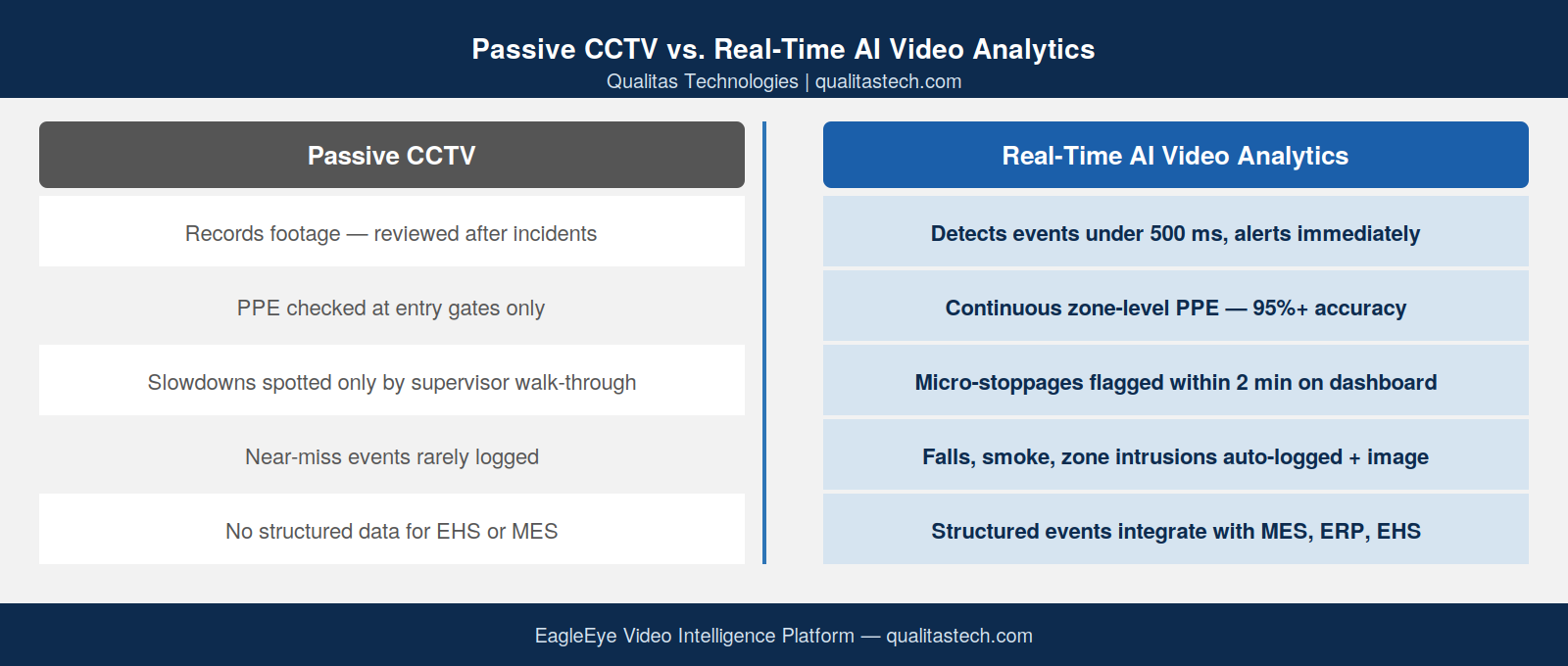
A mid-sized manufacturing plant typically has between 20 and 100 cameras installed across the shop floor. Those cameras produce a continuous flood of footage — but in most facilities, that footage is reviewed only when something goes wrong. A worker is injured. A dispute needs to be resolved. A batch goes missing. By the time anyone looks at the recording, the opportunity to prevent the incident has long passed.
Passive surveillance also places an impossible cognitive load on human operators. Sustained monitoring of more than two or three live camera feeds degrades human attention rapidly; by the fourth feed, meaningful detection of events drops significantly. Safety teams know this. EHS managers know this. Yet most factories have invested in camera hardware without the intelligence layer that makes continuous monitoring operationally useful.
The gap passive CCTV leaves open is significant:
- PPE non-compliance happens routinely inside the production floor, away from entry checkpoints where compliance is typically verified.
- Restricted zone intrusion near moving machinery, electrical panels, and chemical storage rarely triggers any real-time response.
- Line slowdowns and micro-stoppages accumulate into significant throughput loss before a supervisor notices anything abnormal.
- Near-miss events — falls, collisions, smoke — go unlogged unless someone happened to be watching the right screen at the right moment.
The fundamental problem is not the number of cameras. It is that the footage has no layer of intelligence running on it continuously.
What Real-Time Detection Actually Enables
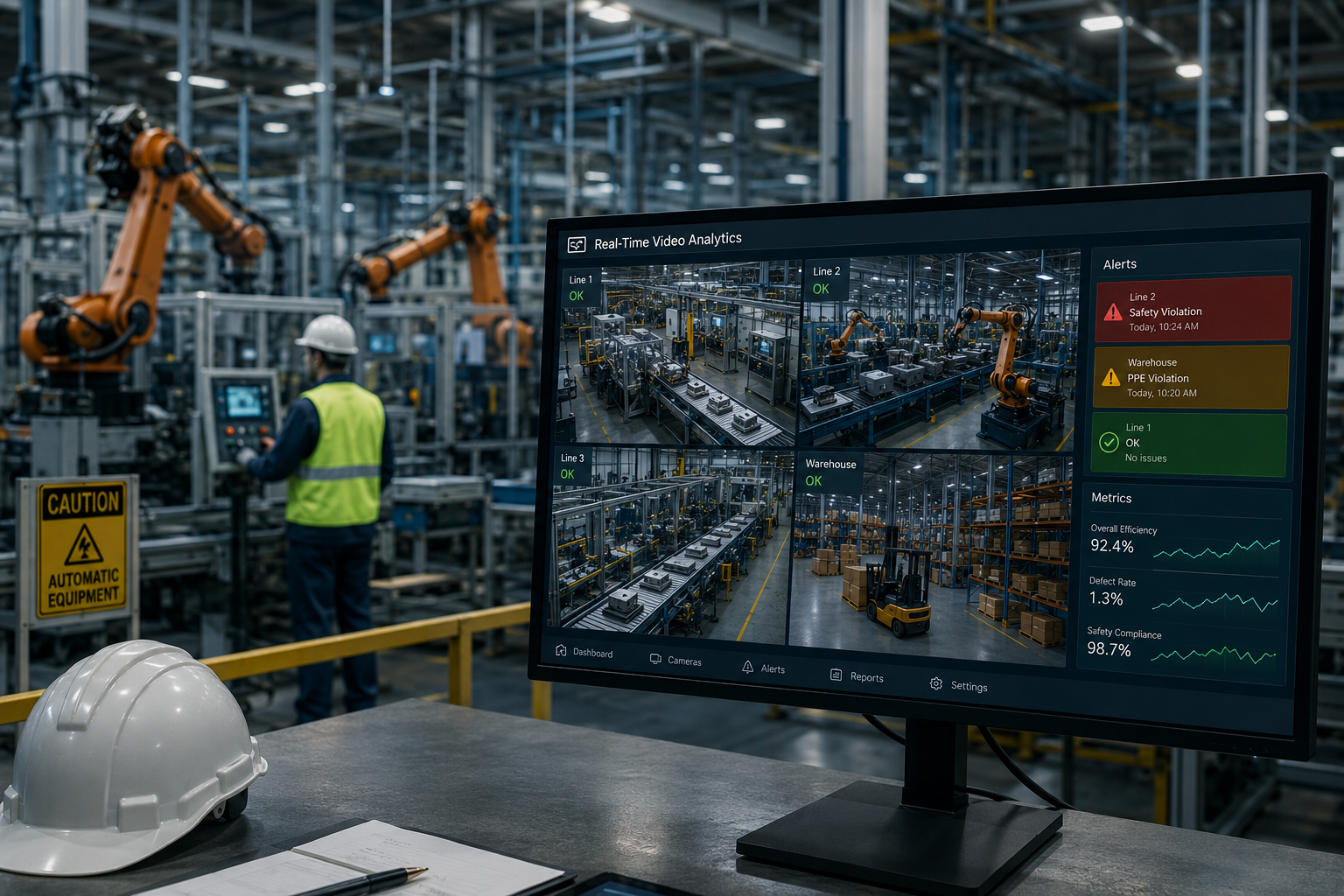
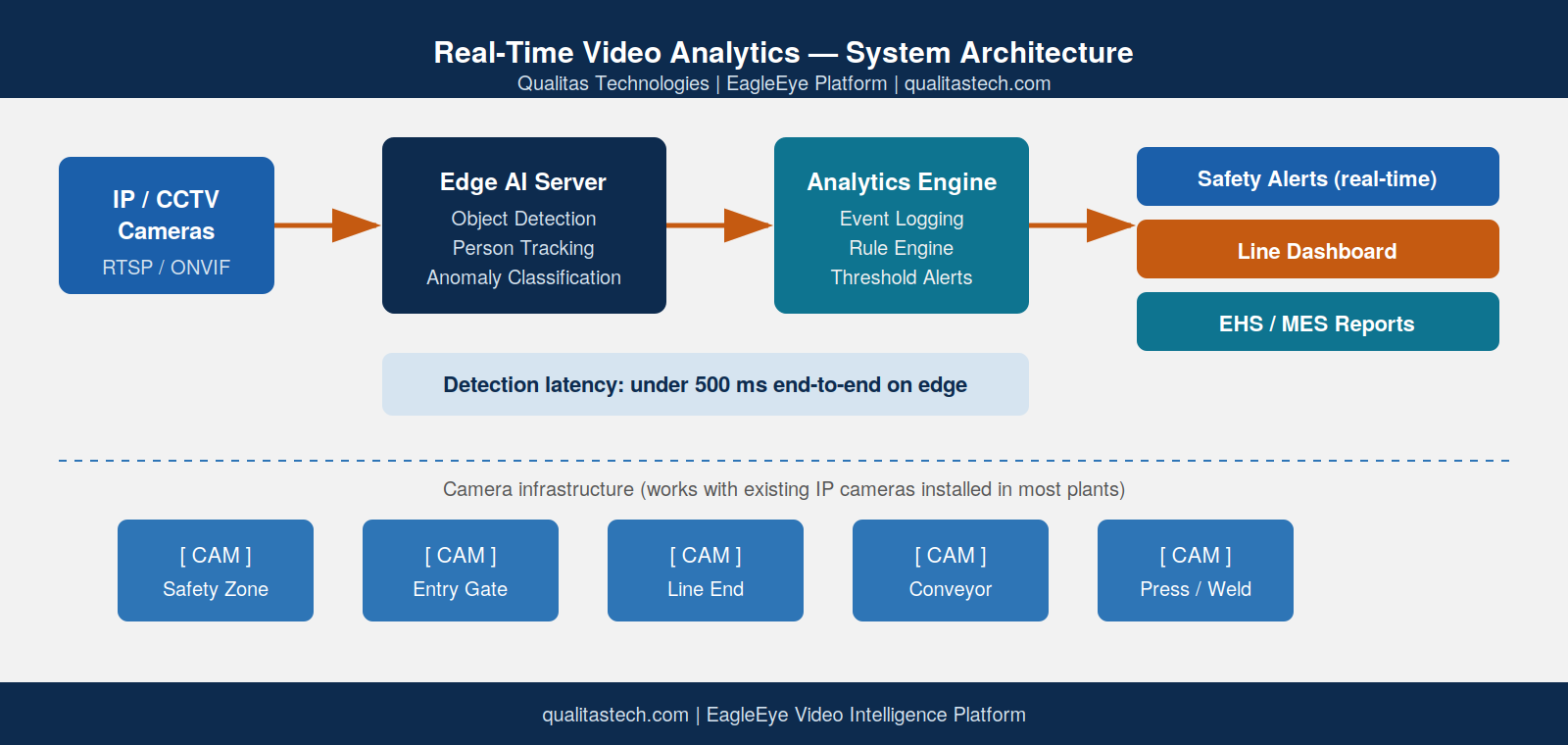
Real time video analytics processes live camera streams through AI models — object detection, pose estimation, tracking, anomaly classification — and generates structured event data in near real time, typically within 500 milliseconds of an event occurring on camera. The output is not more footage. It is a decision: alert, log, escalate, or dismiss.
This distinction matters operationally. The shift supervisor does not need to watch a screen. The system watches, and only surfaces what requires human attention. When a worker enters a hazardous zone without a face shield, the alert fires immediately. When the packing line drops below 80% of its target rate for more than two minutes, the dashboard flags it.
Understanding this framing is also relevant for how you evaluate vendors. Many systems marketed as “video analytics” are actually post-hoc analysis tools — they process recorded footage in batches or generate reports overnight. True real-time detection means the inference engine is running on live streams, not historical clips. For safety applications, the difference between a 500-millisecond alert and a 12-hour report is the difference between preventing an incident and investigating one. You can read more about the technical considerations behind choosing between image-based and video-based inspection in our earlier piece on image and video-based inspection in industrial settings.
PPE Compliance Monitoring: From Checkpoint to Continuous
The most common failure mode of PPE programs is spatial. Workers are checked at the entry gate — helmet and vest confirmed — and then compliance enforcement effectively stops. Inside the production floor, near press lines, welding bays, chemical zones, and heavy equipment corridors, no one is watching continuously. Studies and field deployments consistently show that PPE violations inside the plant are far more frequent than entry-point checks suggest.
AI-powered PPE detection changes the enforcement model from checkpoint-based to zone-based and continuous. The system is configured per zone: helmet and vest in the stamping bay, gloves and goggles in the chemical mixing area, ear protection near the press banks. Cameras covering those zones run detection continuously. When a violation is identified, the alert routes to the relevant supervisor’s device — phone, tablet, or control room screen — within seconds.
Production-grade PPE detection systems achieve above 95% accuracy in most industrial environments after a brief calibration period. Early deployments typically see accuracy in the 88–92% range for the first two weeks, improving to 95%+ by day 30 as the model adapts to the facility’s specific lighting conditions, camera angles, and worker uniform variations. Importantly, this performance is achievable without replacing existing cameras — the AI engine runs on standard RTSP or ONVIF streams from IP cameras already installed on the floor.
For EHS managers, the practical outputs are:
- Zone-level compliance scorecards — percentage of person-hours in each zone with full PPE, tracked shift by shift
- Violation logs with timestamped images — audit-ready records for internal reviews and regulatory inspections
- Trend analysis — identifying which zones, shifts, or work types generate the highest non-compliance rates
- Near-miss detection — flagging events like personnel entering forklift corridors, fire/smoke detection, and person-down scenarios
Field context:
Most manufacturing plants deploying AI video safety analytics already have compatible IP camera infrastructure. The camera hardware is rarely the obstacle — it is the absence of an intelligent inference layer running on that existing infrastructure.
Line Throughput Analytics: Making Production Slowdowns Visible
Video analytics for safety and video analytics for production are, in most facilities, the same camera infrastructure serving two different analytical workloads. While the safety layer watches for human events, the production layer watches for operational events — parts moving too slowly, conveyors stopping, buffers overflowing, assembly stations idle.
Vision-based visual process automation and production counting solutions can track units passing a reference point on a conveyor at line speed, without any contact sensor or encoder integration. Combined with cycle time monitoring — measuring the elapsed time between events at specific stations — this gives plant heads a live view of where throughput is being lost.
The types of events a production-focused analytics layer can detect include:
- Micro-stoppages — sub-minute pauses on a line that accumulate into significant OEE losses but rarely appear in manual logs
- Bottleneck identification — which station is consistently causing upstream queuing or downstream starvation
- Operator cycle time variance — whether a manual assembly step is running within expected time bounds across shifts
- Change-over monitoring — time taken to clear one product and establish the next, flagged when it exceeds the target window
This data has a direct relationship to the cost of quality in manufacturing operations. Line slowdowns that are caught in near real time and corrected within the same shift are vastly less expensive than slowdowns that are discovered in the morning report and traced back to a root cause 18 hours later.
Deployment Guide: What a Phased Rollout Looks Like
One of the consistent barriers to adoption is a perception that deploying video analytics requires a full infrastructure overhaul. In practice, most industrial facilities can start with a focused deployment on one or two zones and expand from there. The key steps:
- Camera audit. Confirm that existing cameras produce RTSP or ONVIF-compatible streams. In the majority of plants with cameras installed in the past decade, this check will pass without any hardware replacement.
- Zone definition and rule configuration. Work with the EHS team to define which zones require which PPE, which areas are restricted to authorised personnel only, and which production stations should have throughput thresholds set.
- Edge server deployment. An inference server is installed on-premises, connected to the camera network. For most single-plant deployments, a single GPU-enabled server handles 20–30 camera streams simultaneously.
- Model calibration period (2–4 weeks). The AI models are calibrated against your facility’s specific conditions — lighting, camera angles, worker uniforms, shift patterns. Alert thresholds are tuned to minimise false positives before going live.
- Integration with existing systems. Alert routing connects to existing EHS workflows. Production data feeds into MES or ERP dashboards. Most integrations are handled via REST API or standard industrial protocols.
- Expansion. Once the first zone is stable, additional cameras and zones are onboarded with significantly lower calibration effort, since the base models are already trained on your facility’s visual environment.
The EagleEye AI inspection and video intelligence platform supports this exact architecture — modular onboarding, human-in-the-loop review for borderline events, and a web-based dashboard for both safety compliance and production analytics in a single interface.
Frequently Asked Questions
What is real-time video analytics in manufacturing?
Real-time video analytics uses AI models running on live camera feeds to detect events — PPE violations, unsafe zone entries, line stoppages, bottlenecks — within milliseconds, rather than recording footage for later review.
Can AI video analytics work with existing CCTV cameras?
Yes. Most deployments integrate with existing IP cameras that support RTSP or ONVIF streams. The AI inference runs on an edge server connected to the camera network — no camera replacement is required in the majority of industrial sites.
How accurate is AI-based PPE detection on the factory floor?
Production-grade PPE detection systems achieve above 95% accuracy in most industrial environments. Accuracy typically improves from 88–92% in the first two weeks to 95%+ by day 30 as the model calibrates to your facility’s specific lighting and camera conditions.
What is the difference between video analytics for safety and for production monitoring?
Safety analytics detects hazardous events — PPE non-compliance, restricted zone intrusion, fire or smoke, personnel falls. Production analytics tracks throughput metrics — cycle time, parts count, bottleneck identification, and OEE. A well-architected system handles both from the same camera infrastructure.
How long does it take to deploy a video analytics system in a factory?
A phased deployment typically runs 4–8 weeks for a single zone or line: camera audit in week one, AI model configuration in weeks two and three, system integration in weeks four through six, and live monitoring with alert routing from week seven onwards.
See the application note: Discuss a video analytics deployment for your facility with a Qualitas vision engineer — we map your existing camera infrastructure to the right detection architecture before recommending any hardware.