A surface crack on a bearing roller. A lap on a cold-rolled strip. Scale pressed into a hot-worked pipe. These are not cosmetic nuisances — they are failure modes that downstream customers discover, and your quality team pays for. Metal surface defect detection has always been the hardest QC problem in manufacturing: the defects are real, the stakes are high, and the inspection methods have historically been inadequate. Manual visual inspection misses too much at speed. Rule-based machine vision breaks on reflective, variable metal surfaces. AI-based vision — deep learning trained on real production images — is now closing that gap in steel mills, automotive lines, and precision component plants.
Metal Surface Defect Detection: From Manual Visual Inspection to AI Vision
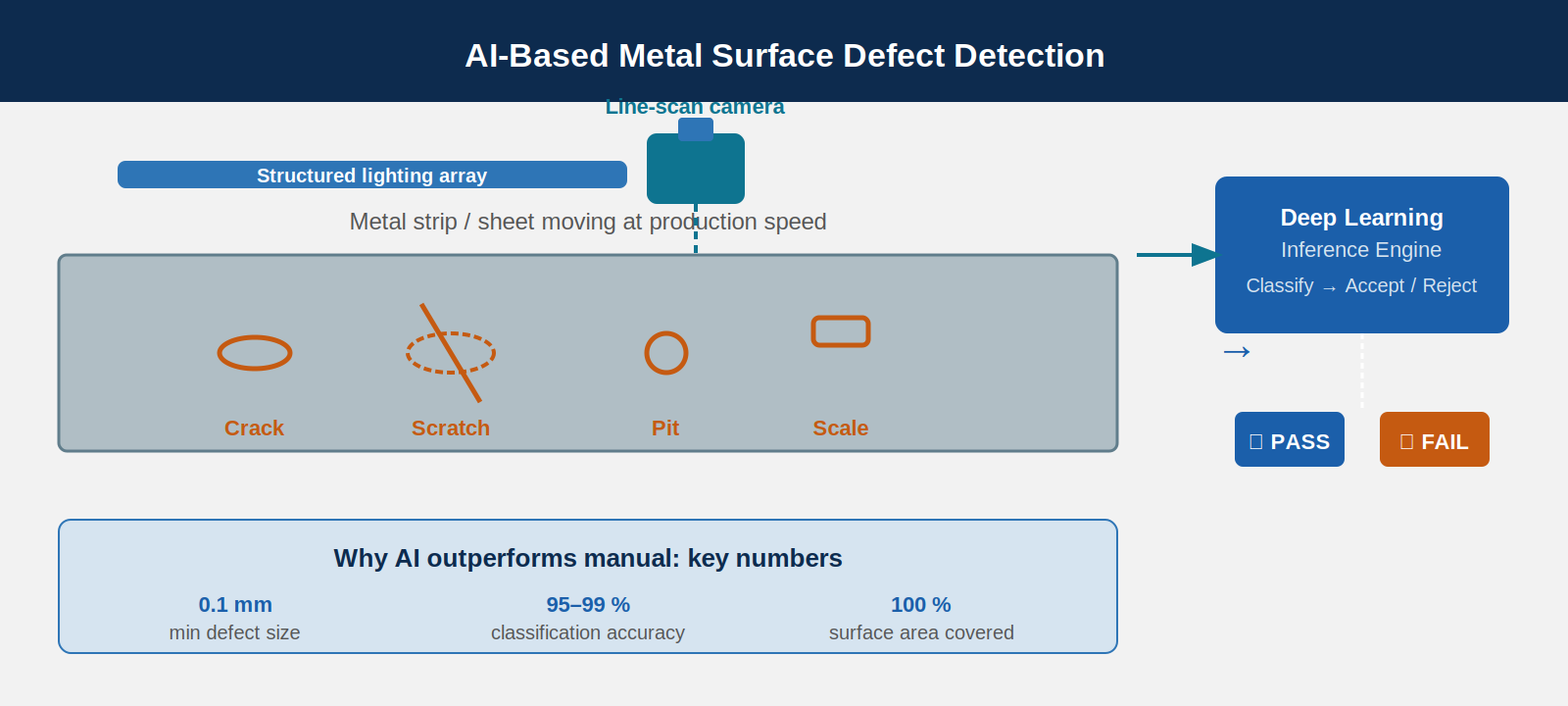
Common Metal Surface Defects — and Why They Matter
Metal surface defects fall into two broad families: process-induced and material-induced. Both cause downstream failures — paint adhesion problems, fatigue cracking, bearing failure, dimensional rejects — that are far more expensive to fix at the customer’s facility than at the source line.
The most common defects vary by product form:
- Rolled strip and sheet: rolled-in scale, laps, slivers, transverse cracks, longitudinal cracks, scratches from roll surface damage, and edge cracks from rolling schedule errors.
- Pipe and tube: seams, laps, laminations, pitting from descaler malfunction, and weld-line defects in ERW and HSAW pipe.
- Castings and forgings: porosity, blow holes, cold shuts, sand inclusions, shrinkage voids, and surface roughness outside specification.
- Precision machined parts (bearings, rollers, shafts): grinding burn, spiral marks, chamfer defects, unfinished surfaces, and micro-cracks invisible to the naked eye.
- Automotive stamped panels: dents, paint primer miss-outs, weld spatter, surface scratches, and forming-related wrinkles.
The economic cost is real. Scrap and rework cost the average manufacturer up to 2.2% of annual revenue — a figure that compounds rapidly at scale. A ₹500 crore plant running at that miss rate loses ₹11 crore to preventable quality failures every year. Surface defects are among the leading contributors.
Why Manual Visual Inspection Fails on Metal
Manual inspection has one fundamental physical limit: at line speeds above 5 m/s (300 m/min), the human eye cannot resolve defects smaller than 0.5mm. At a hot strip mill running at 10–20 m/s, human inspection is simply not physically possible. But even on slower lines, manual inspection has structural weaknesses that go beyond speed.
Metal surfaces are optically hostile. Specular reflections shift as coils pass under fixed lighting. Scale patterns vary with chemistry. The visual boundary between an acceptable cosmetic variation and a true defect is exactly the kind of nuanced judgment that degrades over a long shift. Studies consistently show that inspector attention, and therefore detection rate, declines measurably after the first two hours of a shift.
The outcome is predictable: false rejects waste good parts, and missed defects reach customers. Both are expensive. Manual inspection on metal lines typically achieves 60–70% defect detection rates under real production conditions — not because the inspectors are inattentive, but because the task exceeds what the human visual system can sustain at production speed.
Machine Vision Setup for Metal Surface Inspection
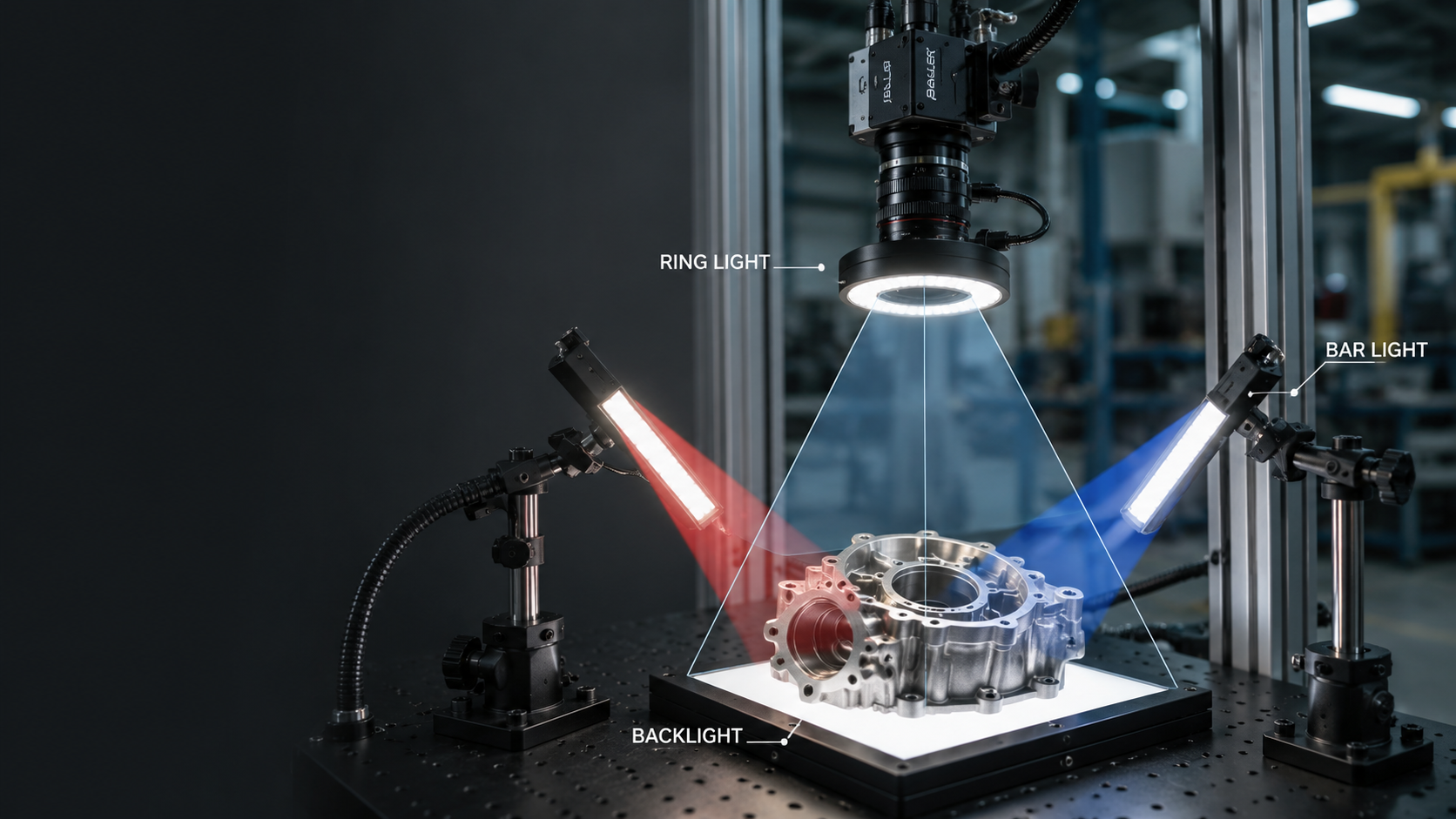
A well-designed metal surface inspection system has four components that must work together: illumination, image acquisition, processing hardware, and the detection algorithm.
Illumination is the most underestimated element. Metal surfaces require carefully designed lighting — structured line light, dark-field illumination, or directional coaxial lighting — to make defects visible at all. The wrong lighting design makes cracks invisible and raises false alarm rates. Lighting must also be stable across temperature and ambient light variation in the factory.
Key hardware choices:
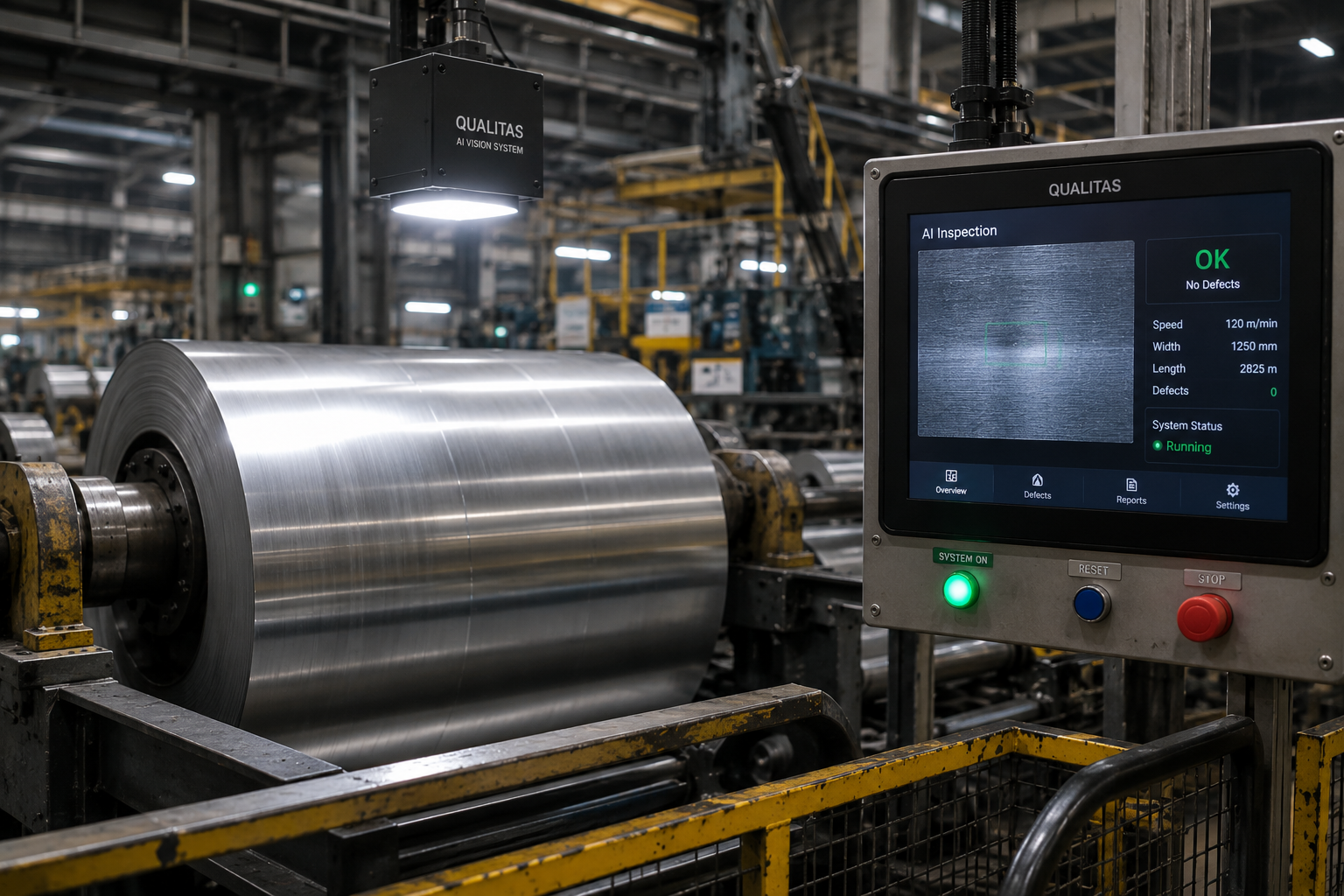
- Line-scan cameras for continuous web inspection (strip, pipe, sheet) — they capture one line at a time and build a full-resolution image as the material moves.
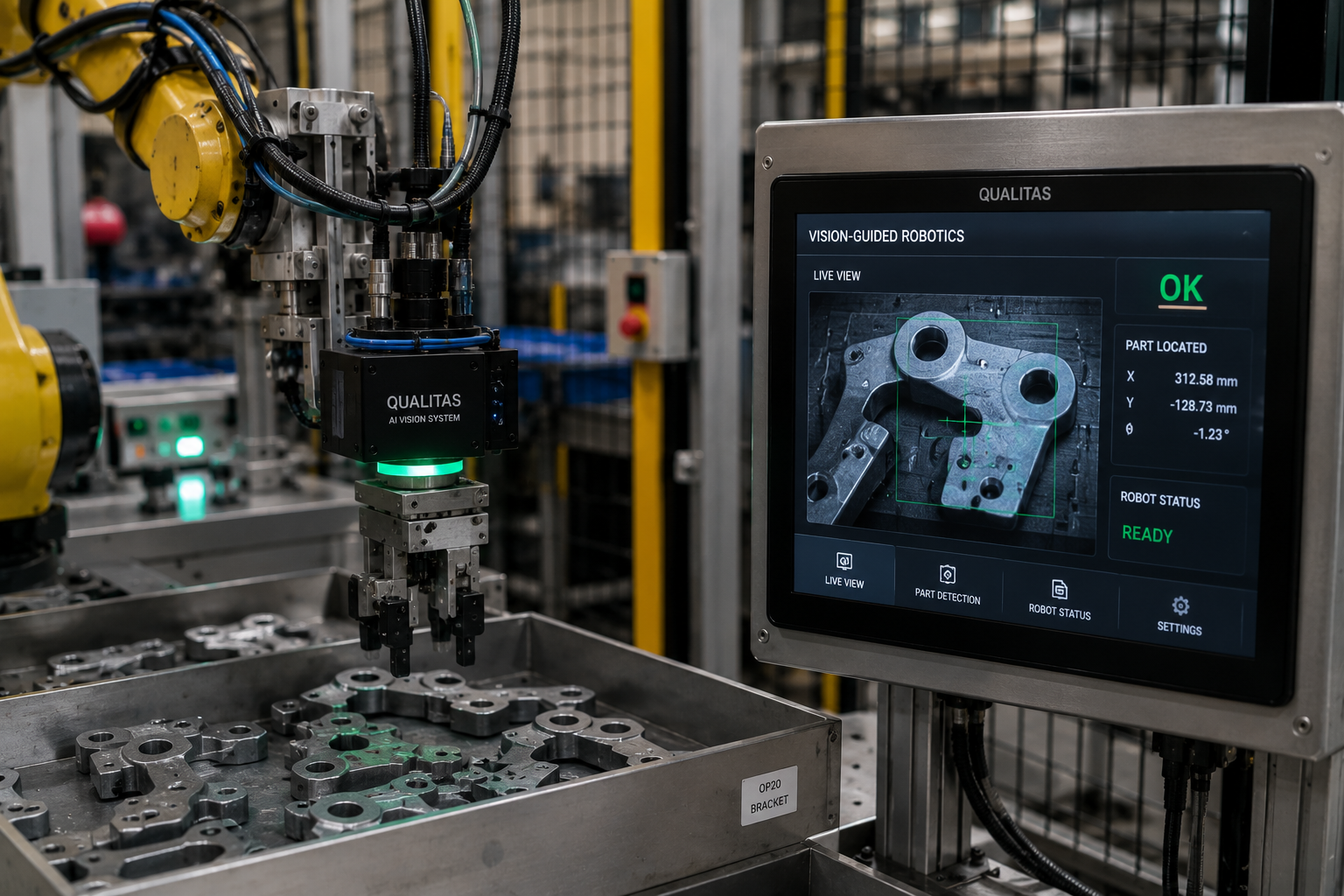
- Area-scan cameras for discrete parts (castings, bearing components, stampings) — capture a full frame per trigger.
- Camera resolution must match defect size and line speed — detecting a 0.1mm crack on a 1m-wide strip at 10 m/s requires careful pixel pitch and frame rate calculation.
- Processing hardware — industrial PCs with GPU acceleration (Intel Core Ultra, NVIDIA) for deep learning inference at frame rates above 60 fps.
The physical setup then integrates with the production line PLC via digital I/O or Modbus, triggering reject gates or alarming the operator within milliseconds of a defect classification.
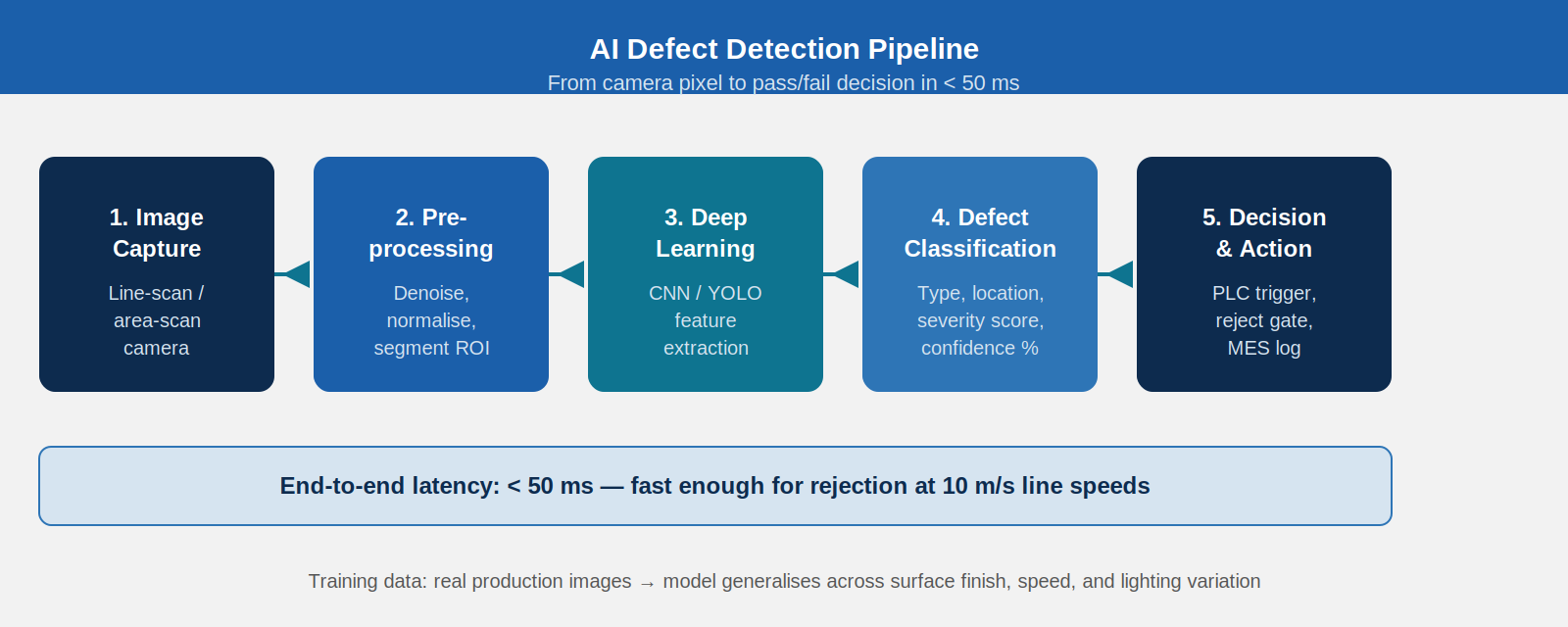
Why Deep Learning Changes the Game
Traditional rule-based machine vision systems work on pixel thresholds and edge detection algorithms. They are fast, deterministic, and completely brittle on real metal surfaces. A coil with slightly different chemistry produces a different scale texture. A shift in ambient temperature changes the specular reflection angle. The rules break, and the system either over-rejects good metal or misses real defects.
Deep learning approaches the problem differently. A convolutional neural network (CNN) or YOLO-based model learns the visual signature of defects from hundreds or thousands of labelled production images — including the ambiguous cases, the lighting variations, and the cosmetic-versus-functional boundary that experienced inspectors learn over years. Once trained, the model generalises. It does not need a new threshold for every coil grade or every surface finish. It handles the variation that breaks rule-based systems.
The performance improvement is measurable. Rule-based systems typically achieve 70–80% detection accuracy on variable metal surfaces. AI-trained deep learning models consistently reach 95–99% accuracy on the same lines — with false reject rates low enough that production managers accept the system rather than override it.
Three additional advantages matter in practice:
- Defect localisation: AI models output bounding boxes or segmentation masks, not just pass/fail signals. Operators see exactly where the defect is, which enables root-cause analysis.
- Continuous improvement: New defect types can be added by annotating examples and retraining — no rules to rewrite.
- Process intelligence: Defect frequency, type distribution, and spatial pattern across the coil width give process engineers actionable data to fix the upstream cause.
Industry Applications — Where It Runs Today
Metal surface defect detection is not a laboratory concept. It runs in production across multiple industries, at varying line speeds and part geometries.
Steel mills (hot and cold rolling): Compact Strip Mill lines produce steel at speeds where human inspection is physically impossible. AI vision systems inspect both surfaces simultaneously on moving strip, classifying defects and providing per-coil quality reports. We have deployed a deep learning surface defect identification system on a hot steel strip CSM line, where AI-based classification achieved results that manual methods could not approach. See the hot steel strip defect identification in a Compact Strip Mill for details.
Bearing and precision component manufacturing: Bearing cages, taper rollers, and steel balls require inspection for scratches, unfinished surfaces, chamfer defects, and spiral marks. The geometry is complex and the volumes are high — manual inspection at 100% is not economically viable. Our bearing cage surface defect inspection with AI vision covers a deployment at India’s largest bearing cage manufacturer, where a wide diameter range and 80mm depth requirement made the setup technically demanding.
Automotive castings and stamped panels: Cast parts develop blow holes, overruns, and surface inclusions. Stamped panels require primer miss-out detection before painting. Deep learning handles the nuanced boundary between acceptable cosmetic variation and a true primer defect — a boundary rule-based systems cannot hold reliably.
Precision metal injection moulded (MIM) components: Fluorescent penetrant NDT under UV light surfaces sub-surface cracks invisible under normal illumination. Automating the UV image capture and classification replaces a highly fatiguing manual step. Our UV light surface defect inspection on a precision MIM component shows this in production at a global precision parts supplier.
Pipe and tube: Line-scan cameras with dark-field illumination resolve 0.1mm seams and laps at pipe travel speeds above 20 m/min — across both outer and inner surfaces.
The EagleEye surface defect identification solution covers the full range of these applications — from anomaly detection on unstructured defect types to structured classification systems with 100+ defect categories.
Frequently Asked Questions
What types of defects can AI vision detect on metal surfaces?
AI-based machine vision systems detect cracks, scratches, pits, inclusions, scale, rolled-in scale, laps, seams, and coating defects — among others. Modern deep learning models can classify over 200 defect types and detect anomalies as small as 0.1mm at full production speed.
Why does manual inspection fail for metal surface defects?
Above 5 m/s line speed, the human eye physically cannot resolve sub-0.5mm defects. Beyond speed, reflective metal surfaces make consistent visual judgement difficult, and inspector detection rates decline measurably after the first two hours of a shift.
How accurate is AI-based metal surface inspection?
Well-trained deep learning vision systems achieve 95–99% accuracy on metal surface defect classification — consistently across shifts, line speeds, and surface finishes. Rule-based systems typically achieve 70–80% on variable metal surfaces.
Which industries benefit most?
The highest impact is in steel rolling mills, automotive (castings, stampings, paint shop), bearing and precision component manufacturing, pipe and tube production, and aerospace sheet metal — any application where surface quality directly affects downstream function or customer acceptance.
What is the ROI of an AI metal surface inspection system?
ROI comes primarily from reduced scrap and rework (up to 2.2% of annual revenue industry-wide), eliminated inspector headcount at end-of-line, and reduced customer returns. Most deployments see payback within 12–18 months depending on line speed and part value.
Continue exploring: If you are evaluating automated inspection for a specific metal application, the overview of why machine vision outperforms manual inspection covers the underlying principles in more depth — a useful starting point before scoping a system.