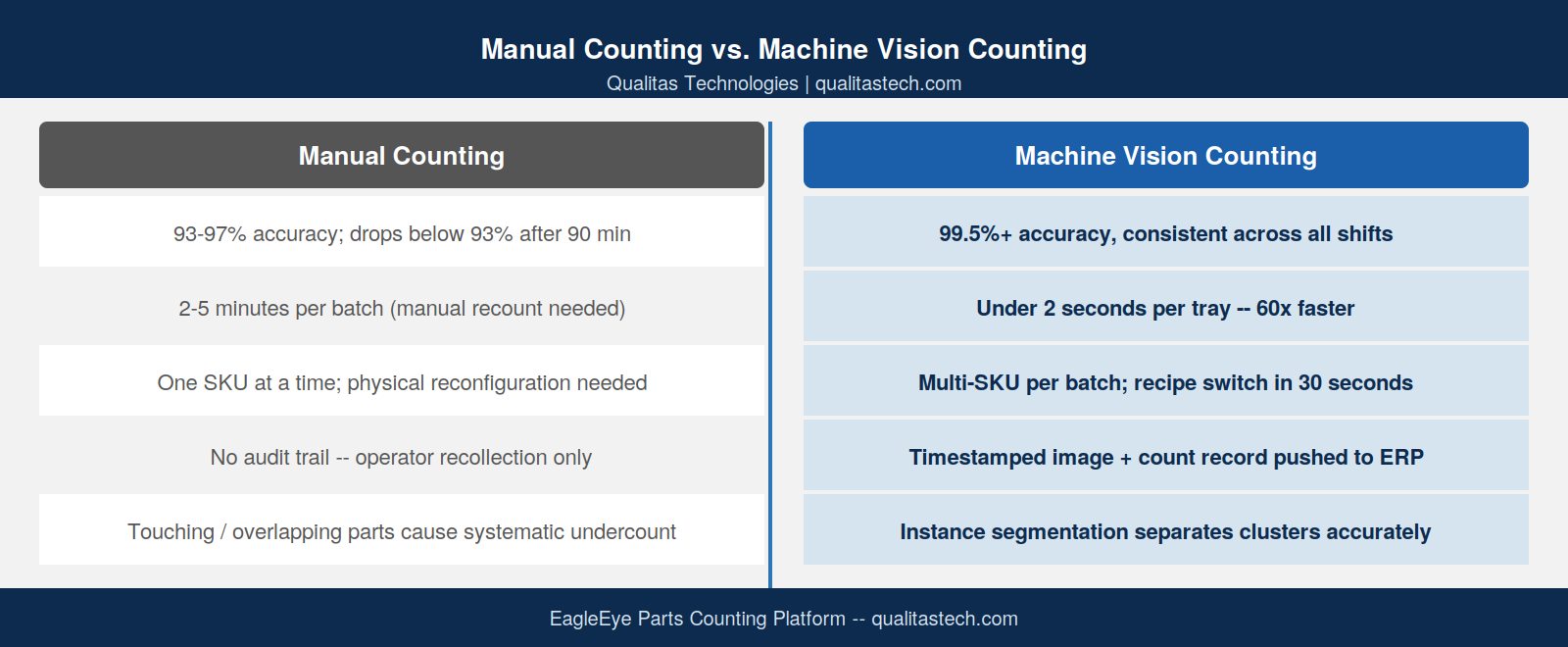
A plant running two counting shifts per day — one operator per station, batches of 200–500 small parts, target accuracy of 100% — is running a losing bet. Human counters operate at 95–97% accuracy under optimal conditions, and that figure degrades below 93% after 90 minutes of the same repetitive task. On a high-volume line producing piston rings, fasteners, or electronic connectors, even a 1% miscounting rate adds up to thousands of short-shipment or over-pack events per month. A small parts counting machine built on machine vision solves the problem at the root: the system does not fatigue, does not round, and generates a timestamped image record of every batch it counts.
Automatic Part Counting with Machine Vision: Replacing Manual Counting on the Line
The Real Cost of Manual Counting on the Line
Manual part counting looks like a low-risk task — until you map what a miscount actually costs downstream. A single short-shipment to an OEM assembly line triggers emergency airfreight, a line-stop penalty, and an 8D corrective action process. For an automotive supplier shipping piston rings, a missing ring that reaches engine assembly is a warranty claim, not just a rework event.
The accuracy ceiling for human counters is tighter than most plant managers realise. Under controlled conditions with rested operators, counting accuracy reaches 95–97%. But counting is a repetitive, high-volume, low-stimulation task — after 90 minutes on the same station, error rates can double. These are not anomalies; they are the expected output of human neurology applied to work it was never designed to sustain.
The methods typically deployed to compensate all carry their own failure modes:
- Weight-based counting scales drift when parts vary in weight across production tolerances — a common reality for cast or stamped components.
- Photosensor / break-beam counters fail with touching or overlapping parts and cannot distinguish one SKU from another.
- Sampling-based QC catches systematic errors statistically but misses localised short-count events at the end of a reel or bag lot.
- Manual double-count slows the line and still only raises accuracy to around 98% — the second counter makes correlated errors on the same clusters that tripped the first.
The deeper problem is the absence of an audit trail. Manual counting leaves no per-batch record of how the count was performed, by whom, or at what confidence level. When a customer dispute arrives, there is no evidence — only operator recollection.
How Vision-Based Counting Works
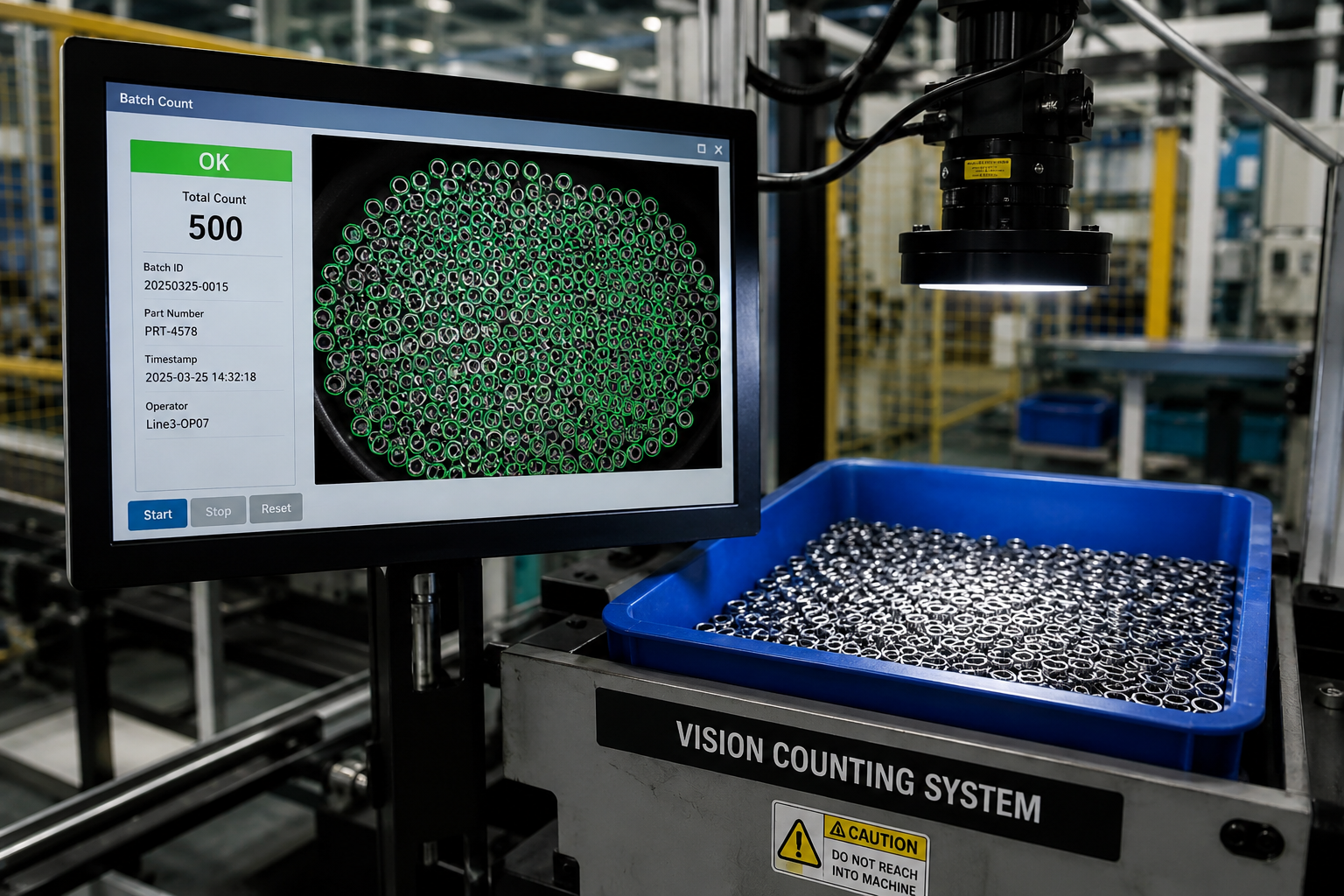
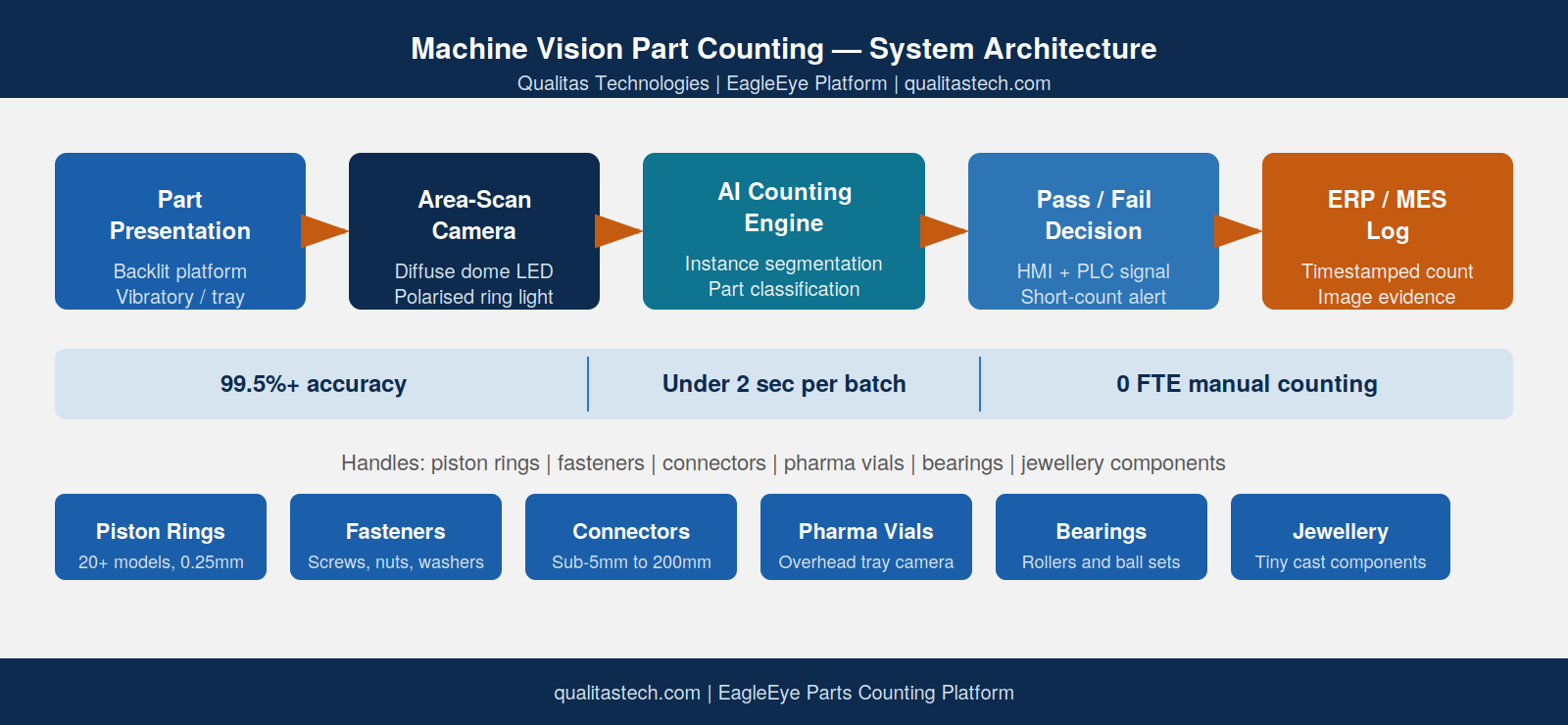
Part counting machine vision operates differently from mechanical counting methods in one fundamental way: it sees the geometry of each individual part, not just a signal that something passed a beam. A high-resolution area-scan camera captures the entire presentation platform — tray, conveyor section, or vibratory bowl output — in a single frame. An AI model running instance segmentation then draws a boundary around each individual part, classifying and counting them even when they are touching or partially overlapping.
The key components of a production-ready system:
- Area-scan camera positioned overhead, with resolution chosen based on the smallest part feature that needs to be resolved.
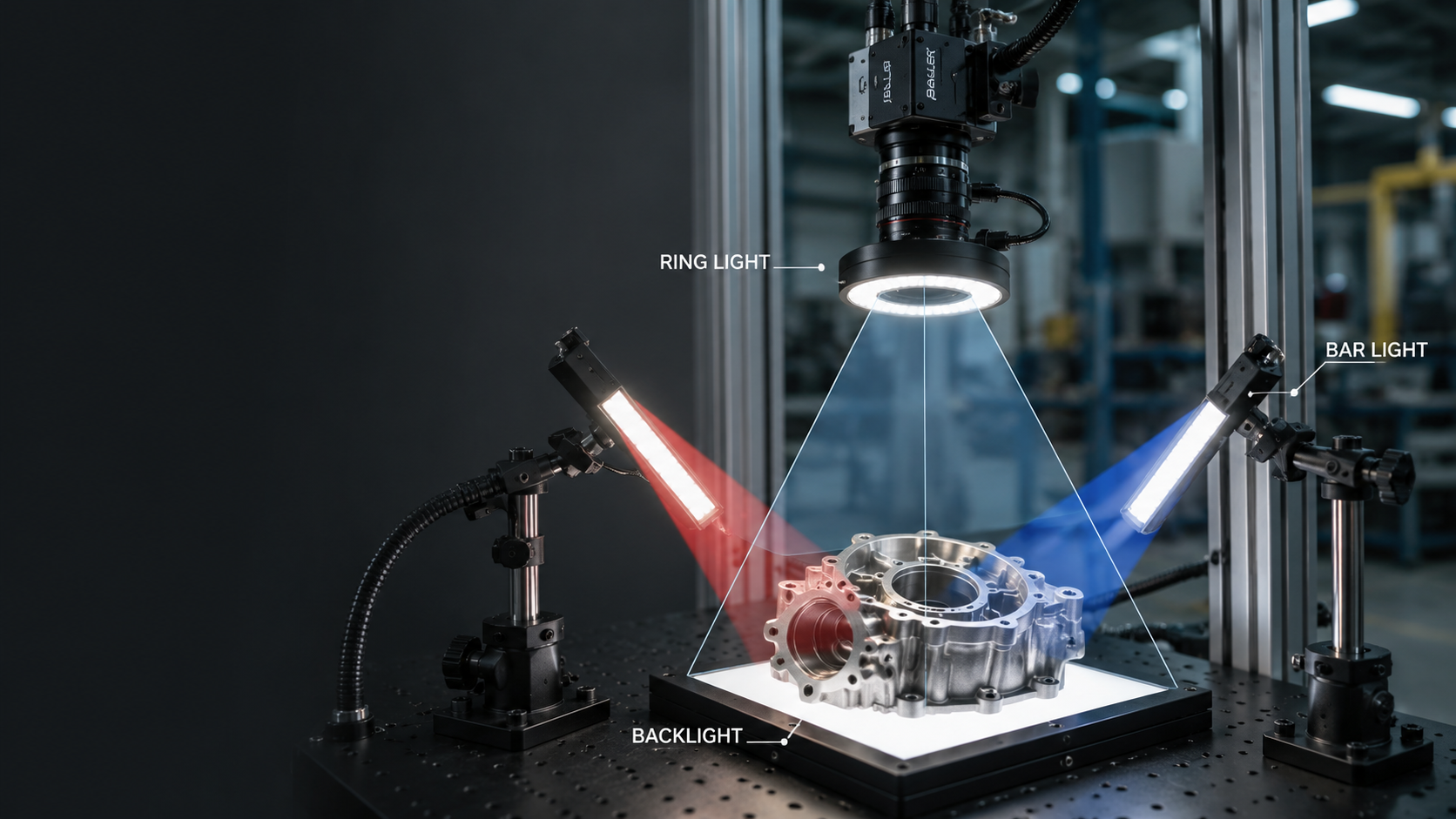
- Backlit platform or diffuse dome LED illumination to produce clean silhouette edges on opaque parts and suppress reflections on metallic surfaces. For polished or plated components, polarised ring lighting is added to eliminate specular artefacts.
- Instance segmentation model that identifies and masks individual part boundaries per frame — handling clusters, touching parts, and size variation within a single inference pass completed in under 500 milliseconds.
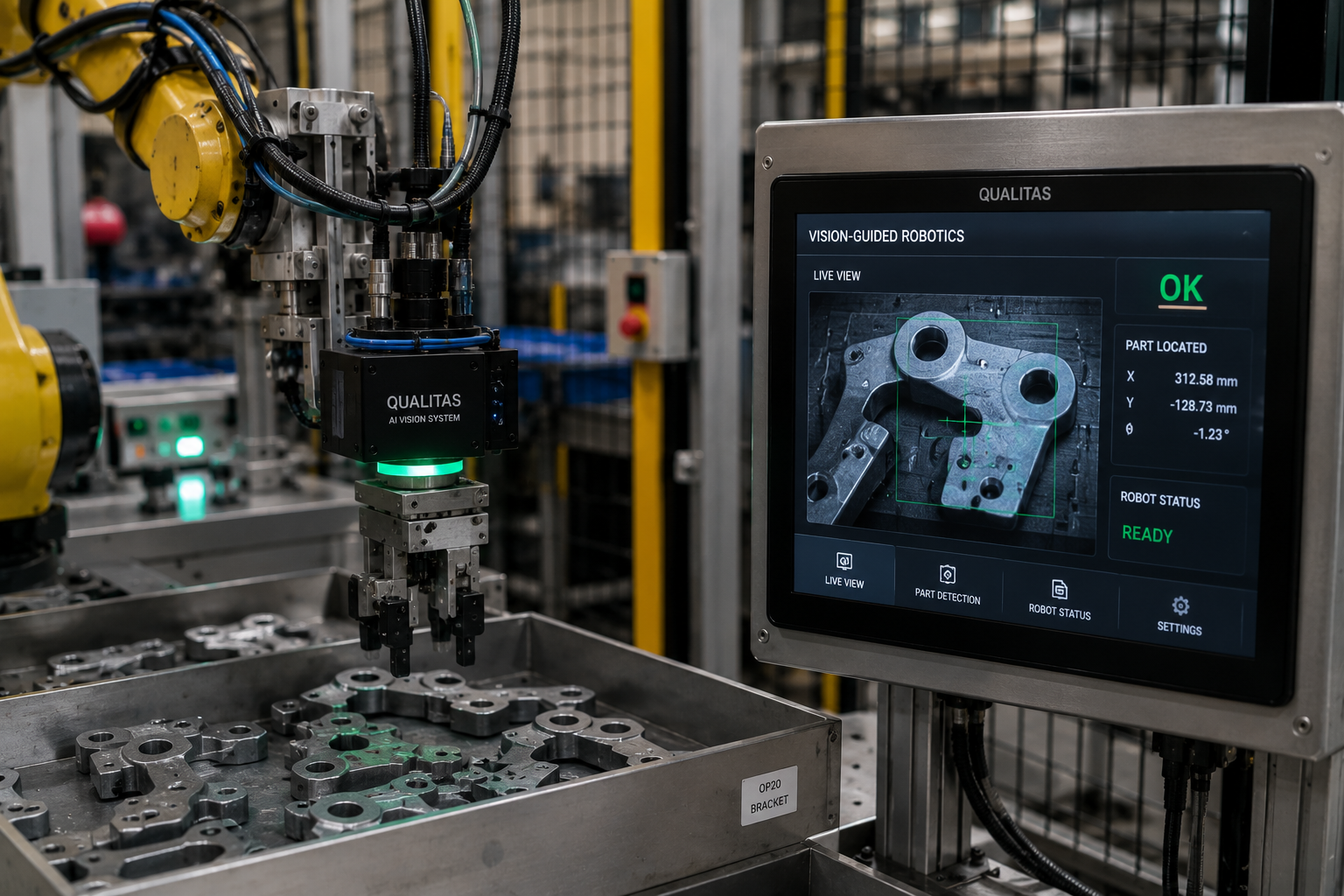
- Pass/fail logic and PLC interface that signals the operator via HMI and communicates the result to the line control system in real time.
- ERP/MES integration via REST API or OPC-UA, pushing a timestamped count record and image evidence to inventory systems without manual data entry.
The full cycle — part presentation to confirmed count — completes in under 2 seconds for a standard tray load. For reference, manual counting of the same batch typically takes 2–5 minutes. The automatic part counting app note with architecture and ROI benchmarks walks through the full system design in detail.
Accuracy on Small and Difficult Parts
The question plant engineers ask most often is not whether vision counting works in general — it is whether it works on their specific part. Small parts, reflective surfaces, mixed batches, and very thin stacked components each introduce challenges that need to be addressed at the optics and model-training level.
| Part Condition | Challenge | Vision Solution |
| Touching / overlapping parts | Human eye merges clusters; photosensors count as one | Instance segmentation separates boundaries — over 98% separation rate |
| Reflective metallic surfaces | Specular highlights cause false edges and missed detections | Polarised ring + diffuse dome lighting eliminates glare artefacts |
| Mixed SKU batches | Operator may misclassify near-identical variants under fatigue | AI classifies each part simultaneously — over 99% part-type accuracy |
| Very thin stacked rings | Axial stack count — individual rings visually indistinguishable | Side-view dual-camera pair counts the stack profile edge-on |
| Sub-5 mm micro-parts | Too small for reliable human count at production speed | High-resolution macro lens + backlit platform for clean contrast |
Across these scenarios, well-deployed vision systems consistently achieve 99.5%+ count accuracy — a figure that holds across shifts, across operators, and across model changeovers. The automated parts counting machine page documents the range of part types handled in live production deployments.
Multi-Lane and Multi-Model Counting
A single-station vision counting system is the right starting point. The more common engineering question is how the architecture scales when a plant has multiple counting stations, multiple product families, or needs to count more than one SKU simultaneously on the same line.
Multi-lane deployments run parallel camera stations above adjacent vibratory outputs or conveyor lanes, feeding the same inference server. A single mid-range GPU handles four to six concurrent counting stations without throughput compromise — inference for each frame completes in under 500 milliseconds. Results from all lanes are aggregated and reported on a single plant-floor dashboard.
Multi-model flexibility — switching between product recipes without mechanical reconfiguration — is handled at the software layer. The operator selects the active product on the HMI touchscreen; the system loads the corresponding model weights, target count, and acceptance thresholds. Changeover takes under 30 seconds. For lines running 10–20 SKU changes per shift, this is a meaningful operational difference from mechanical counters that require physical adjustment between products. The industrial piece counting machine page covers how this scales across automotive, pharma, and electronics applications.
Payback context:
For a mid-volume plant processing 50–200 batches per shift, eliminating counting errors and reducing cycle time from minutes to under 2 seconds produces a typical payback period of 10–14 months. A single short-shipment event to an OEM customer — triggering emergency airfreight, line-stop penalties, and an 8D corrective action process — can represent a significant fraction of that payback on its own.
Case: Piston Ring Counting at 99.5%+ Accuracy
Piston rings are one of the most demanding small-parts counting applications in automotive manufacturing. The rings must be counted by model — axial thickness, outer diameter, and surface coating all vary across a production set — and the count must be exact. A missing ring at engine assembly is a defect that does not surface until the engine is tested or returned in warranty.
Qualitas has deployed piston ring counting systems for automotive tier-1 suppliers handling over 20 distinct ring models at a single station, with axial thickness as thin as 0.25 mm. The system uses a side-view dual-camera configuration to count the ring stack edge-on: the 310 mm maximum stack length is divided across two camera fields of view, each covering half the range. A model trained per camera section counts visible rings and the totals are summed.
The result: 400 rings counted in under 1 second. Accuracy at 99.5%+. All 20+ ring variants are handled through software recipe selection — no physical changeover required between models. Operators who previously spent a full shift manually counting and re-counting ring stacks now load and unload the station while the system handles every count automatically. This deployment is referenced in the visual process automation solutions section of the Qualitas site.
Frequently Asked Questions
How accurate is machine vision for counting small parts?
Well-deployed vision systems with instance segmentation achieve 99.5%+ count accuracy across mixed part sizes. Human counters operate at 93–97% under optimal conditions, with error rates doubling after 90 minutes of repetitive work.
Can a vision-based counting system handle multiple part types in one batch?
Yes. AI-based instance segmentation identifies and classifies each part individually in a single camera frame, so mixed-SKU batches can be counted and segregated simultaneously — without mechanical reconfiguration between products.
What is the cycle time for machine vision part counting?
A typical system completes a full batch count in under 2 seconds per tray load, including inference and pass/fail decision. Manual counting of the same batch takes 2–5 minutes depending on part size and quantity.
Does vision-based counting require replacing existing production line equipment?
Not typically. The camera and backlit platform are added inline above or alongside the existing presentation or packing station. Parts continue to feed via the existing vibratory bowl, conveyor, or manual tray — the vision system is additive.
What parts are difficult for vision-based counting systems to handle?
Transparent parts, highly reflective metallic surfaces, and parts presented in deep stacks rather than a single spread layer present challenges. Polarised and diffuse LED illumination resolves most reflectivity issues. Stacked parts require a spreading mechanism before the counting station.
Ready to evaluate a counting system for your line? Discuss a parts counting deployment for your line with a Qualitas vision engineer — we review your part geometry, batch sizes, and existing feed mechanism before recommending a configuration.