The Polymer Identification Challenge
Common plastics such as PET, HDPE, PVC, PP, LDPE, and PS are visually indistinguishable once mixed in a waste stream — the same clear bottle shape can be PET or PP, and colour tells a sorter almost nothing once labels, dirt, and fading are involved. Differentiation actually happens in the near-infrared spectrum, where each polymer's chemical bonds absorb light at characteristic wavelengths, well beyond what an RGB camera can see. Demand for clean separation is also a commercial question, not just an environmental one: market-research estimates put the global recycled-plastics market at roughly $58–61 billion in 2025, with most firms projecting continued growth this decade, which raises the value of a bale that actually meets a buyer's purity spec.
| Challenge Area | Root Cause | Downstream Impact |
|---|---|---|
| Visually identical polymers | PET, PP, and LDPE share overlapping colour and texture ranges | Mis-sorted bales and reprocessing failures |
| Black plastic identification | Carbon-black pigment absorbs strongly across the visible and near-infrared range | Documented industry limitation — black items are frequently unsortable by standard optical or NIR/SWIR systems and go to landfill or thermal recovery |
| Surface contamination | Dirt, labels, and grease mask surface colour cues | RGB cameras mis-classify dirty or labelled items |
| PVC cross-contamination | PVC in a PET stream releases hydrochloric acid at PET reprocessing temperatures | Published research on PET/PVC reprocessing shows even a small fraction of PVC can visibly degrade colour and mechanical properties across an entire reprocessed batch |
| Mixed flake / fragment streams | Shredded fragments lack a reliable shape or colour identity | Few viable non-spectral classification methods at that fragment size |
| Manual sorting throughput | Human sorters are typically limited to on the order of 20–40 items per minute in published time-and-motion studies | Insufficient for high-volume conveyor rates |
Why RGB Cameras Cannot Solve This
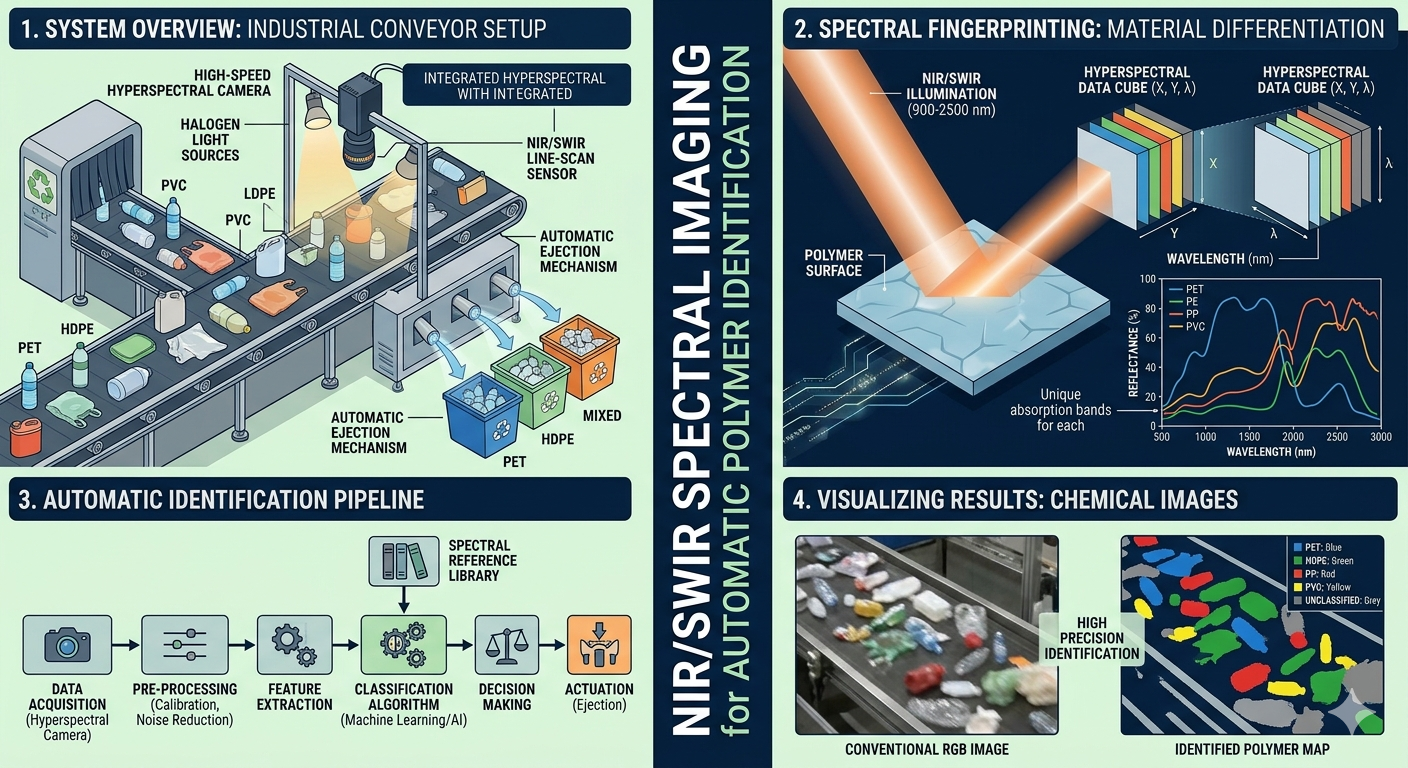
NIR/SWIR imaging captures each polymer's absorption profile across roughly 900–1700 nm, a region governed by molecular bond chemistry rather than surface colour. Published spectroscopy references place PET's characteristic absorption features near 1130–1170 nm, 1420 nm, and 1660 nm, and PVC's near 1200 nm, 1420 nm, and 1480 nm — exact peak positions vary somewhat by instrument and reference method, so a deployed system is always calibrated against the customer's own resin and additive mix rather than assumed from a table. This chemical signature is what makes spectral imaging viable for in-line polymer identification at conveyor speed in a way RGB cannot match — with the caveat, discussed below, that the technique has real limits of its own.
| Detection Method | Limitation for Polymer ID | Verdict |
|---|---|---|
| RGB camera (visible light) | Reads surface colour only — cannot detect polymer chemistry | Not viable for polymer ID |
| Manual visual sorting | Cannot reliably distinguish same-colour polymers; accuracy degrades with fatigue | Not viable at MRF scale |
| Density / float-sink | Batch process only; cannot sort on a moving conveyor | Not inline-capable |
| X-ray fluorescence (XRF) | Detects elements, not polymer bonds; point-scan speed | Impractical at line speed |
| Raman spectroscopy | Point measurement only; dark and fluorescent surfaces interfere with the signal | Limited throughput |
| Human + conveyor system | Accuracy on same-colour or clear/white mixed streams degrades measurably at conveyor speed | Not reliable for a fixed purity target |
Suggested NIR/SWIR System Architecture
A global-shutter SWIR camera (640×512-pixel InGaAs sensors are a common, commercially available format at this wavelength range) mounted above the conveyor, paired with high-intensity illumination across 900–1700 nm. Per-pixel spectral classification models, trained on the customer's own polymer and contamination samples, assign a material identity to each region of the belt and produce a labelled material map at video rate. Classification results trigger timed air-jet nozzles or mechanical diverters, routing items to the correct polymer bin and rejecting PVC and non-plastic contaminants. This is the same sensing principle already running in production at commercial single-stream MRFs worldwide, from vendors such as TOMRA, Pellenc ST, and Steinert — the engineering work here is fitting that principle to the customer's specific feedstock, not inventing a new detection method.
| Polymer | What differentiates it spectrally | What published data / vendor experience suggests | Known caveat |
|---|---|---|---|
| PET | Ester-bond overtone bands, documented near 1130–1170 nm, 1420 nm, and 1660 nm | Commercial NIR sorters commonly report high-90s% purity on clear and lightly coloured PET streams | Accuracy drops on heavily printed, multi-layer, or deeply pigmented bottles |
| HDPE / LDPE / PP (polyolefins) | C–H overtone bands in a similar region to one another | Separating polyolefins from PET or PVC is well established | The published literature notes polyolefin sub-grades are measurably harder to separate from each other than from PET or PVC — this is a known limitation of NIR sorting generally, not a gap specific to any one vendor |
| PVC | Chlorine-bearing bonds give a distinct band cluster around 1200–1480 nm | Because a missed PVC item is far costlier than a false reject, PVC gates are usually tuned for high recall (favouring rejection) rather than balanced accuracy | Trace PVC still matters — see the contamination note above |
| PS | Aromatic-ring overtone bands | Comparable performance to PET/PP when unpigmented | Foamed/expanded PS behaves differently under NIR than rigid PS and may need separate tuning |
| Carbon-black / dark plastics | Carbon black absorbs broadly across the visible and near-infrared range | This is a documented, industry-wide blind spot for reflectance-based NIR/SWIR, not a solvable calibration problem | Requires a complementary approach — NIR-detectable masterbatches upstream, mid-infrared sensing, or thermographic/AI methods — scoped as a separate project stream |
Expected Outcomes & ROI
The honest baseline for expected performance is what the published literature and commercial deployments already show, not a number invented for this note. A 2026 peer-reviewed study using infrared spectroscopy and machine learning reported 97.1% accuracy identifying ten plastic types from an independent test set that deliberately included dark and contaminated samples; other NIR studies on cleaner or narrower resin sets report accuracy in the high-90s to above 99%. Real-world performance on any given line depends heavily on contamination level, fragment condition, and colour mix, and should be validated against the customer's own material during feasibility rather than assumed from any single published figure.
| Outcome Area | What the Evidence Shows | What It Means for a Sorting Line |
|---|---|---|
| Classification accuracy vs. manual/RGB | Peer-reviewed NIR/FTIR studies report accuracy from the high-90s up to 99%+ on multi-polymer test sets, including dark samples in at least one 2026 study | A well-tuned inline system can plausibly reach similar accuracy on comparable feedstock — confirmed per project, not guaranteed by default |
| Manual sorting throughput ceiling | Time-and-motion studies put manual picking at roughly 20–40 items per minute per sorter | Conveyor-speed optical sorting removes that ceiling, shifting sorter roles toward oversight and QC rather than eliminating them outright |
| PVC cross-contamination risk | Published research shows even a small fraction of PVC can visibly degrade an entire reprocessed PET batch | The PVC-reject gate is the highest-value decision on the line and is worth tuning conservatively even at the cost of some false rejects |
| Black / dark plastic recovery | Carbon-black pigmentation is a documented blind spot for reflectance NIR/SWIR, reportedly leaving on the order of 10% of feedstock unsortable by standard NIR at some facilities | This system does not resolve black-plastic sorting by itself; recovering that fraction needs a complementary sensing method or an upstream masterbatch change, scoped separately |
Implementation Considerations
Rollout typically follows a phased path rather than a single cutover: a feasibility study collecting and spectrally scanning the customer's own samples across their actual contamination and colour range; a monitoring-only install that validates classification against manually verified ground truth before any diverter is wired to actuate; and a final phase that activates actuation once accuracy on real production material meets the agreed target. Exact phase durations depend on sample availability and line downtime windows and should be scoped per project rather than fixed in advance.