The Inspection Challenge
Every vehicle leaving a manufacturing plant passes through internal transport, yard storage, carrier loading, transit, and a vehicle processing centre before reaching a dealership or customer. Damage can enter at any point, while delayed discovery creates warranty claims and disputes over responsibility without a dependable image record.
| Challenge | Why it matters |
|---|---|
| Missed transit damage | Surfaces later as a warranty claim or dealer dispute, with no image record of when it occurred. |
| Inconsistent inspector judgement | The same defect can receive a different verdict depending on inspector, shift, and fatigue level. |
| Outdoor lighting variability | Sun angle, glare, weather, vehicle colour, and finish change what is visible throughout the day. |
| Fleet diversity | Coverage must remain dependable across hatchbacks, sedans, SUVs, and other vehicle sizes. |
Why Traditional Inspection Falls Short
Unaided visual inspection cannot sustain an objective standard at dispatch-yard volume. The weakness isn't a fixed accuracy ceiling — published Sandia research on precision-manufactured parts found inspectors correctly rejected 85% of defective items while also incorrectly rejecting 35% of acceptable ones in that specific study, and the study itself cautions against treating the figure as a universal inspection benchmark. The stronger, defensible case for a dispatch yard is repeatability rather than a claimed accuracy percentage: every vehicle gets the same capture sequence regardless of inspector fatigue or shift.
- Fine scratches and small paint chips are easy to miss under time pressure or changing light.
- Manual inspection speed scales only by adding people and still produces no consistent photographic audit trail.
- Subjective severity grading makes carrier and OEM liability disputes harder to resolve.
- Paper findings cannot provide a structured record tied to a VIN and timestamp.
The Machine Vision Approach
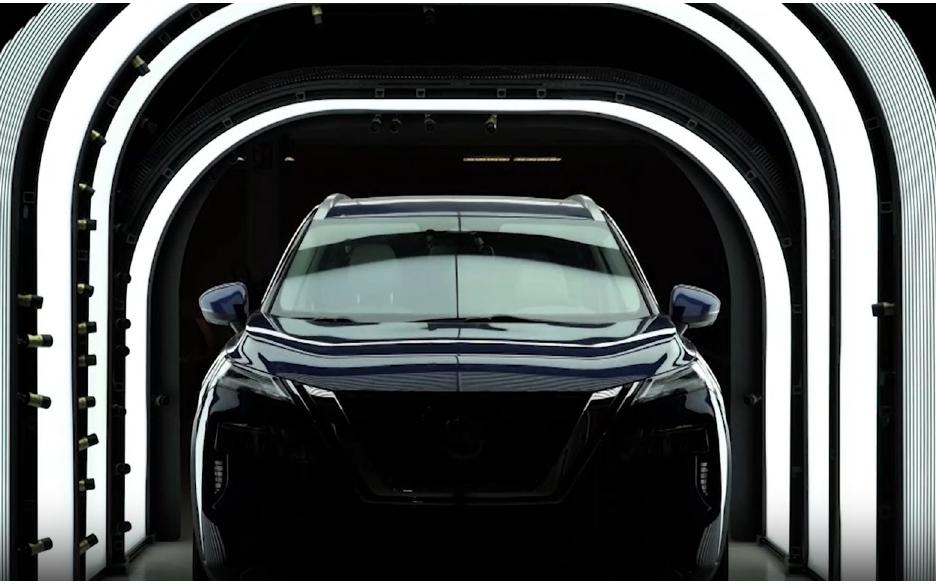
A drive-through gantry uses position-based triggering and a distributed array of global-shutter cameras to cover the front, rear, sides, and roof. Capture follows the vehicle’s actual position rather than a fixed timer, maintaining spatial coverage even when driver-held speed varies during a pass.
Two lighting modes fire in sequence: structured or zebra illumination reveals dents through pattern distortion, while controlled diffuse white light provides the contrast needed for scratches, paint chips, discolouration, and other surface defects. Overlap between adjacent camera zones protects difficult corners and pillar transitions.
| Condition | Illumination mode | Physical basis |
|---|---|---|
| Dents and panel deformation | Structured / zebra light | Pattern distortion reveals local shape change. |
| Scratches and paint chips | White / diffuse light | Contrast highlights linear breaks and reflectance changes. |
| Curved and glossy panels | Both modes, validated by zone | Controlled angles manage glare and non-planar surfaces. |
| Vehicle colour variation | Colour-matrix calibrated exposure | Maintains usable capture across black, white, metallic, and pearl finishes. |
Expected Outcomes & ROI
The system is designed to produce the same capture sequence for every vehicle without fatigue, creating timestamped evidence rather than a subjective handover opinion. First-principles resolution calculations target 1 mm defects at 5 pixels per millimetre; camera count then falls out of that target together with the fleet's vehicle envelope, working distance, and required overlap — for one representative fleet this converged on roughly ten cameras, but the count is an output of those inputs for a given project, not a fixed specification.
- Repeatable full-body image capture across the researched fleet-height range.
- Objective image evidence tied to vehicle identity and inspection time.
- Controlled dual-mode illumination that is less dependent on outdoor conditions.
- Structured image handoff to the customer’s downstream AI, quality, or reporting platform.
Implementation Considerations
Working distance, fleet dimensions, site lighting, and the final defect standard must be confirmed with customer inputs. A short design and prototype phase should validate camera positions, lighting sequences, triggering, and exposure on representative black, white, metallic, and pearl vehicles before full procurement and installation.