The Counting Challenge
Manufacturers handling hundreds to thousands of discrete interconnect and electronics parts per batch — spanning a wide size range, from sub-5 mm micro-pins to 200 mm cable assemblies — routinely rely on a person counting a tray or bin by eye. Published human-factors research on sustained visual-detection tasks is a useful reality check on that control: the classic Mackworth vigilance studies found detection accuracy declines by roughly 10–15% within the first 30 minutes of a repetitive monitoring task, and a Sandia National Laboratories study of trained inspectors performing structured visual checks on precision-manufactured parts found an average 85% hit rate against defects alongside a 35% false-reject rate — the study's authors note this was not far off the wider industry average of around 80%. None of this is specific to counting, but it describes the same sustained-attention task that manual counting asks of an operator, and it argues against assuming manual counts carry near-perfect accuracy by default. Miscounted shipments cause OEM assembly-line stoppages, expedite freight charges, and warranty exposure.
| Challenge Area | Why It Matters |
|---|---|
| Manual counting fatigue | Sustained-attention research shows detection accuracy declines within the first 30–60 minutes of a repetitive task — the same dynamic that degrades manual part counts over a shift. |
| Mixed-size batches | A single count pass has to resolve sub-5 mm pins and 200 mm assemblies without missing the small parts or double-counting the large ones. |
| Overlapping / touching parts | The human eye — and simple photosensors — struggle to separate touching or stacked parts reliably at speed. |
| High SKU variety | A wrong part counted as correct, or a mixed-in SKU that goes unflagged, is a quality escape rather than a shortage. |
| No audit trail | A verbal or paper tally leaves no per-batch record of what was counted, by what method, or verified by whom. |
| Throughput bottleneck | Count stations gate line speed, and adding headcount is the main lever available to manual counting. |
Why Manual and Mechanical Methods Fall Short
The common limitation across every non-vision counting method is that none of them can handle size variation, part proximity, and mixed SKUs at the same time. An instance-segmentation approach is built to address all three from a single image.
| Method | Limitation | Failure Condition |
|---|---|---|
| Manual visual count | Subject to the vigilance-decrement and error-floor effects documented above | Any high-volume batch or long shift |
| Weight-based estimation | Part-to-part weight variation causes count drift | Mixed lots, worn or plated parts |
| Photosensor / break-beam | Cannot reliably distinguish touching parts | Overlapping or clustered parts |
| Mechanical vibratory counter | Tuned to one part geometry; reconfiguration cost for every new SKU | Multi-SKU batches |
| Barcode scan-and-count | Requires individual part labelling, which most small interconnect parts don't carry | Sub-10 mm components |
| Sampling-based QC | A sample check can miss a short count localised to one bag or reel | End-of-reel/bag lots |
Suggested Machine Vision Architecture
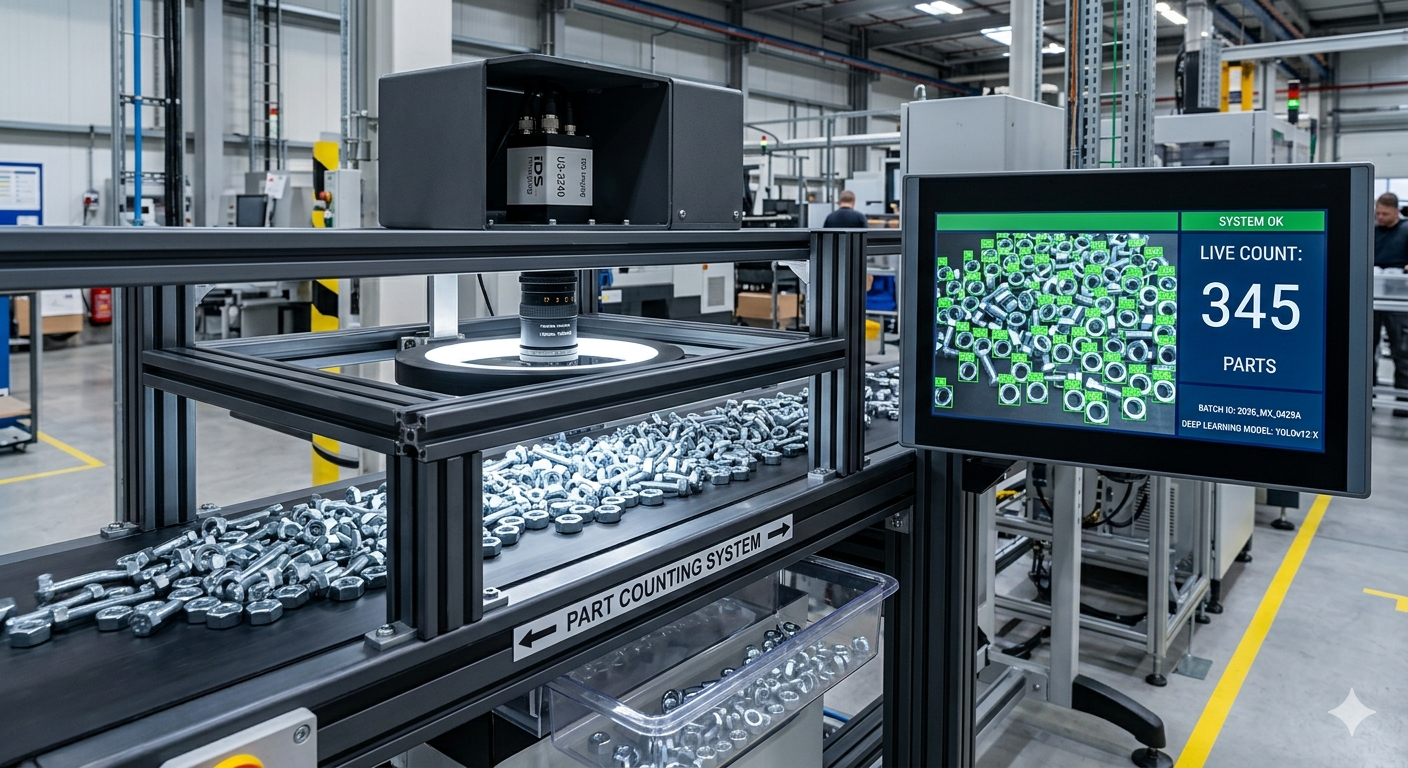
The architecture places a top-view area-scan camera over a backlit or diffuse-lit presentation platform, with parts spread in a single layer so every instance is visible in one frame. An instance-segmentation model — a Mask R-CNN-class network or a modern single-stage detector such as YOLO — draws a boundary around each individual part, including parts that are touching or partially overlapping, rather than returning a simple bounding box. Published benchmarks on comparable small-part industrial detection tasks are a useful anchor here: an enhanced YOLOv5s detector evaluated on a 28-part industrial benchmark derived from the ITODD dataset reached 90.5% precision (Fang et al., Sensors, 2024) — indicative of what current instance-detection models achieve on mixed small parts under realistic occlusion, not a number this note can promise ahead of a feasibility run on a specific customer's parts and lighting.
| Counting Capability | Method | What Determines Performance | Part Size Range |
|---|---|---|---|
| Individual part detection | Instance segmentation (Mask R-CNN-class or YOLO-based) | Published industrial benchmarks report low-90s% precision on mixed small-part sets; final accuracy is confirmed on the customer's own parts and lighting | Sub-5 mm to 200 mm+ |
| Touching / overlapping parts | Per-instance boundary masks rather than bounding boxes | Separation quality depends on part geometry and how much of each instance is visible in-frame | All sizes |
| Mixed-SKU identification | Classification plus geometric features | A committed accuracy figure requires a feasibility run against the actual SKU mix | All sizes |
| Short-count detection | Count vs. target threshold | A pass/fail threshold check flags a shortfall the moment a frame is captured | All batch sizes |
| Wrong-part mix-in flag | Shape and class mismatch | Detection reliability depends on how visually distinct the mixed-in part is from the expected SKU | Distinct geometries |
| Cycle time per frame | Single-frame inference | Modern embedded GPUs run common segmentation models in well under a second per frame; full batch cycle time also depends on part presentation and handling | Standard tray load |
Expected Outcomes & ROI
Because counting shifts from a person's sustained attention to a repeatable imaging and inference pipeline, the same capture-and-count logic runs identically on the first tray of a shift and the last — removing the vigilance-decrement effect that manual counting cannot avoid on its own. Actual accuracy, cycle time, and payback period are functions of the customer's specific parts, tray design, and volume, and should be confirmed on a feasibility run rather than assumed from a generic figure.
- Consistent counting logic across a full shift, independent of operator fatigue.
- A per-batch, timestamped count record for audit and ERP reconciliation, in place of a verbal or paper tally.
- Short-count and wrong-part mix-in flags generated from the same image, rather than sequential manual checks.
- Operator time shifts from counting toward oversight and exception handling once the system is validated on the line.