The Fabrication Workshop Challenge
Workshops that weld and thermally cut steel carry two separate risk profiles at once: an acute safety hazard from arc flash, hot metal, grinding sparks, and fume exposure, and a quality risk from welding and cutting defects that are far cheaper to catch at the torch than after the joint has cooled, been painted, and moved downstream. The U.S. Bureau of Labor Statistics' Census of Fatal Occupational Injuries recorded 53 fatalities among welders, cutters, solderers, and brazers in 2022 alone — a figure that doesn't even count the fitters, grinders, and materials-handling staff exposed to the same floor. Traditional supervision — periodic walkarounds, post-incident CCTV review, and end-of-process inspection — was never built to catch either risk continuously.
| Challenge Area | Current Limitation | Why It Matters |
|---|---|---|
| PPE compliance monitoring | Periodic supervisor walkarounds miss violations between rounds | Gaps in coverage sit directly against arc-flash, spatter-burn, and fume-inhalation exposure |
| Restricted zone enforcement | No automated detection of entry near active welding or cutting stations | Burn and crush risk rises whenever multiple trades share a floor |
| Production visibility | No real-time data on station utilisation or WIP flow | Bottlenecks surface only at shift-end reporting, if at all |
| Weld defect detection | Visual inspection happens after the joint has cooled | Defects such as porosity or undercut are already locked in by the time they're found |
| Cut quality assessment | Manual gauge checks give sampled, not full, coverage | Tolerance escapes surface later, at downstream fit-up |
Why Conventional Systems Fall Short
Standard CCTV remains passive — it records but does not analyse. AWS D1.1, the Structural Welding Code most fabrication shops build their quality process around, requires in Clause 6.9 that all welds be visually inspected by a qualified inspector; the standard doesn't specify how continuous that inspection has to be, and in practice a shop running several simultaneous weld stations rarely has a dedicated inspector watching every one of them in real time. AI vision doesn't replace that inspector or the standard — it gives the same camera infrastructure an active layer that watches continuously between inspection rounds.
| Approach | Limitation | Gap It Leaves |
|---|---|---|
| Standard CCTV monitoring | Passive recording only; humans review footage after events | No real-time alerts, no structured analytics |
| Manual PPE audits | Spot-checks a few times per shift; coverage is incomplete by design | Violations between rounds go unrecorded |
| End-of-process weld inspection | Visual or NDT check after the joint has cooled | Defects are already fixed in the part before anyone sees them |
| Manual production tracking | Paper or operator-entered logs; delayed and error-prone | Bottleneck root-causing happens days later, if at all |
| Periodic quality gauging | Sampled coverage, dependent on operator diligence | Systematic issues can escape multiple samples in a row |
Suggested AI Vision Platform Architecture
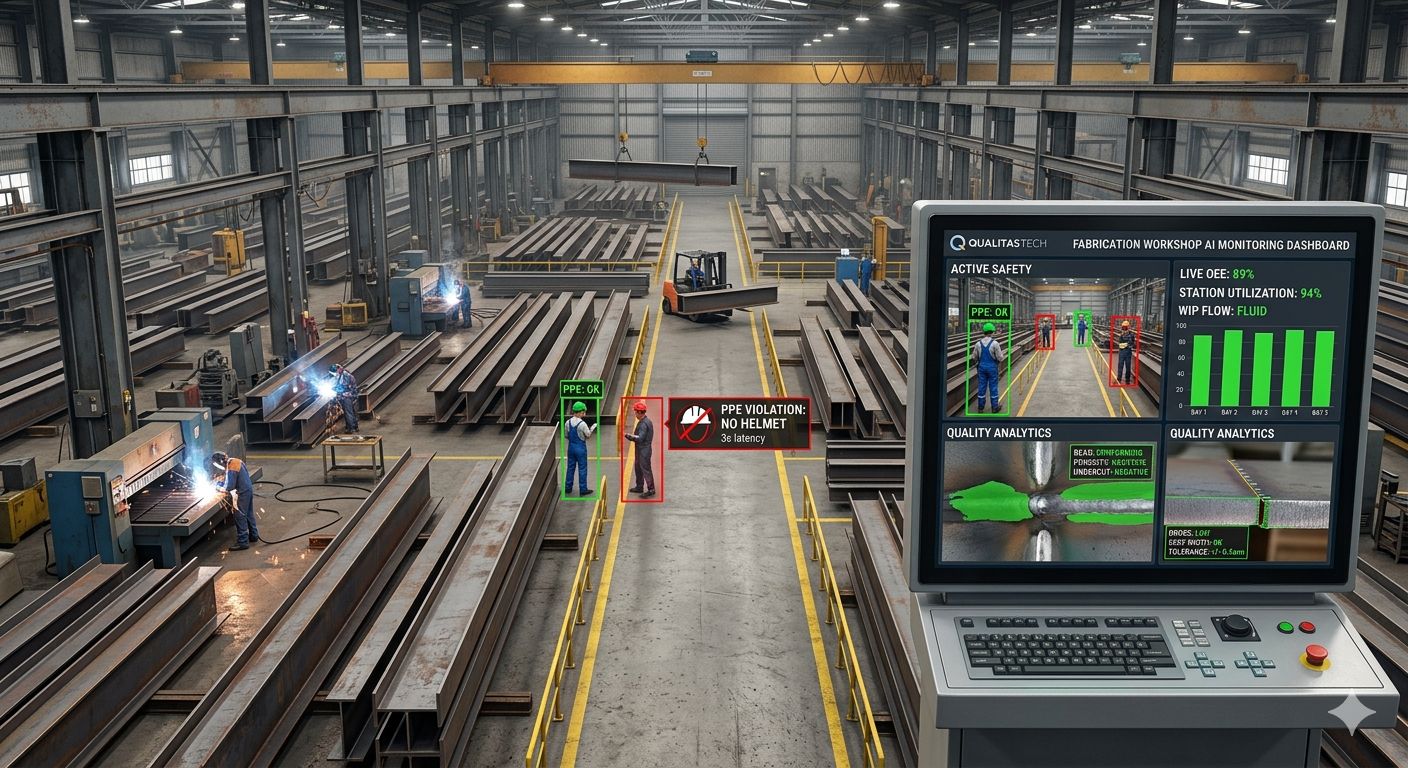
The platform runs four concurrent model streams on a shared edge inference server connected to the shop's existing cameras: PPE and safety monitoring, restricted-zone intrusion, production/station tracking, and weld and cut quality analytics. PPE detection classifies helmet, safety glasses, gloves, hi-vis vest, and safety footwear using the same YOLO-family object-detection approach documented across a growing body of published PPE-monitoring research — recent studies in that literature report [email protected] in roughly the 90–92% range on their own test sets, with accuracy consistently reported as degrading under variable illumination, occlusion, and worker clustering, which is exactly the environment a working weld bay presents. Weld-station cameras capture bead geometry and surface morphology during and immediately after welding; a segmentation model flags porosity, undercut, incomplete fusion, and crater defects — the same defect categories AWS D1.1 Table 8.1 already sets measurable acceptance limits for, including a fractional-millimetre undercut-depth allowance, a capped sum of porosity-void diameters per inch of weld, and zero tolerance for cracks of any size.
| Detection Capability | AI Method | Basis / Evidence | Alert Timing |
|---|---|---|---|
| Helmet, glasses, gloves, vest, footwear | Multi-class PPE object detection | Published YOLO-family PPE studies report [email protected] ≈90–92% under controlled conditions; real-floor accuracy depends on lighting and camera placement | Seconds, edge-side |
| Restricted zone intrusion | Person detection + configurable ROI polygon | Standard person-tracking approach; zones and dwell thresholds are configured per station | Seconds, edge-side |
| Station utilisation (active/idle) | Activity recognition | Feeds a production dashboard rather than a safety alert | Near real time |
| Weld porosity / undercut / incomplete fusion / cracks | Segmentation + anomaly-detection DL model | Defect classes mirror AWS D1.1 Table 8.1; published weld-defect studies report 93–99% accuracy for specific defect/material/process combinations, not as a universal figure | Post-weld, near real time |
| Cut-edge dross / slag accumulation | Texture and morphology DL model | Trained on the customer's own material and cut process rather than a generic dataset | Post-cut |
Expected Outcomes & ROI
The honest case for continuous AI monitoring doesn't rest on a single before/after conversion percentage — no independent, fabrication-specific study of PPE-compliance or weld-rework improvement from adding video analytics turned up in this review, and a number presented as a fixed outcome here would deserve the same skepticism this note is trying to move away from. The defensible case is structural: a camera watches every shift without fatigue, the same segmentation model is applied to the first joint of the shift and the last, and every flagged event is timestamped and retrievable instead of relying on memory.
- Continuous flagging of missing PPE and zone intrusion in place of periodic walkarounds — coverage becomes constant rather than sampled.
- Weld and cut defects are flagged near the point of creation rather than after the joint has cooled and the part has moved downstream, shortening the loop between defect and correction.
- A searchable, timestamped video record replaces memory-based incident reconstruction for investigation and root-cause analysis; the size of that time saving is site-specific and best measured against the shop's own current review process.
- Published rework studies in construction and industrial project literature commonly report rework at roughly 4–10% of total project cost, with a wider 1–20% spread depending on study scope — catching a weld or cut defect at the station rather than after further processing is directionally cheaper, though Qualitas does not claim a fixed percentage reduction without a site-specific before/after measurement.
Implementation Considerations
A phased rollout is typical, prioritising PPE and zone-intrusion monitoring first since it reuses the existing camera network and needs no new hardware or model training on the customer's own defect data. Production tracking follows, integrating dashboards with existing MES or ERP systems. Weld and cut quality analytics come last because they need close-range cameras at each station and on-site model training against the customer's own joint types, materials, and defect history. The actual schedule depends on camera count, network readiness, and how much known-good and known-defect footage is available to train against — it should be confirmed during a site walkthrough rather than assumed from a generic timeline.