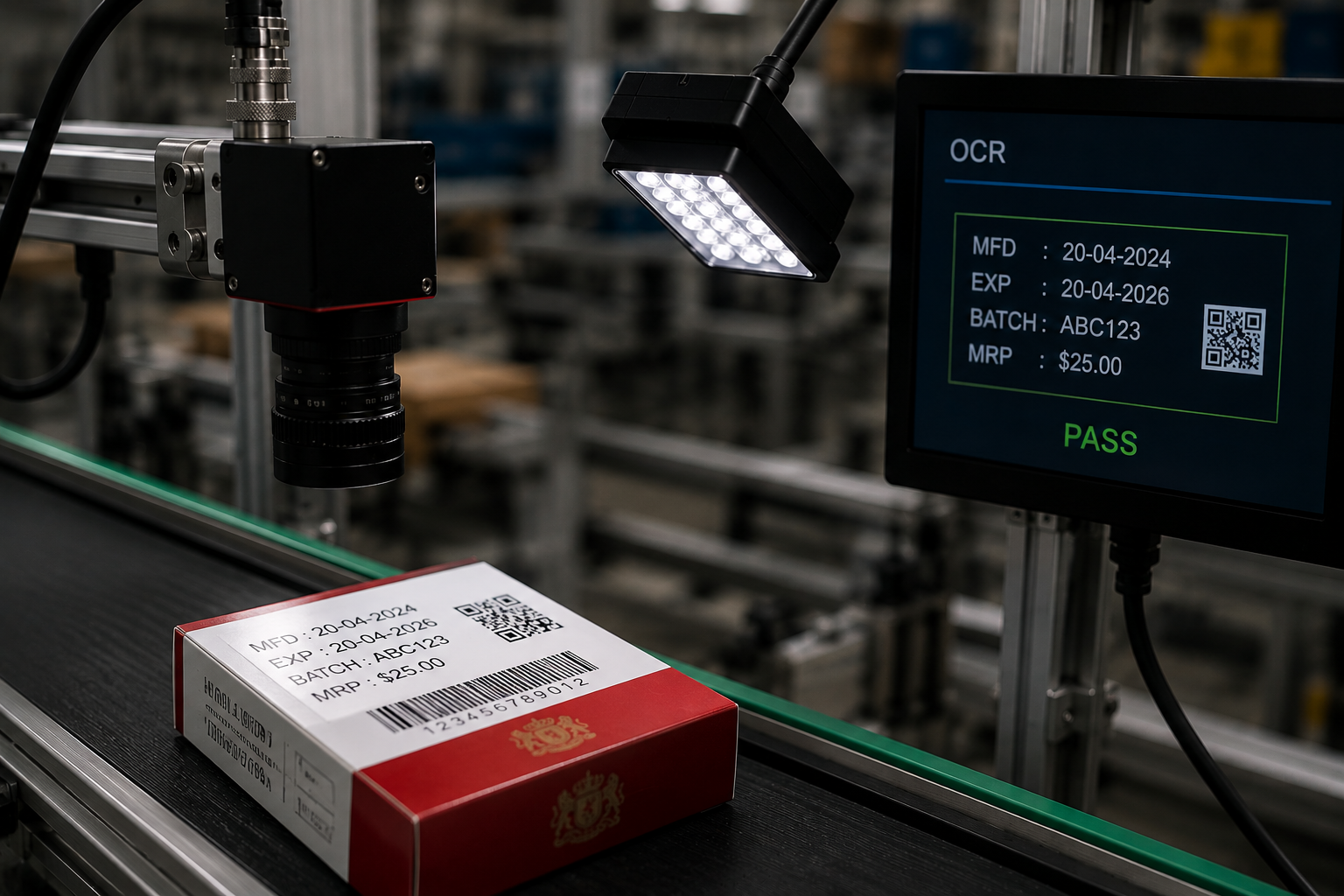
Walk into any pharma blister-packing line, FMCG bottling plant, or automotive component shop in India and you will find the same quiet workhorse running in the background: a camera reading printed text. Lot codes, expiry dates, serial numbers, and label content are no longer just markings — they are the audit trail every recall, every regulator, and every customer eventually demands.
This is why an OCR traceability machine vision system in India has become non-negotiable infrastructure on the modern factory floor. The technology reads what a barcode cannot, verifies what a sensor cannot, and feeds the data straight into the systems that prove your product was made correctly.
What is OCR in an industrial context?
Optical Character Recognition began life in offices, scanning typed documents into editable text. The version that now sits on production lines is a different animal — it reads characters moving past at 60 to 600 parts per minute, on surfaces ranging from plastic foil to corrugated cardboard, etched metal to crimped foil.
A label print inspection AI camera typically works in two complementary modes:
- Character Recognition (OCR). Reads what the text says — date code, lot number, unique product identifier.
- Character Verification (OCV). Compares what was read against what was supposed to be printed (the ERP or MES reference string), character by character.
The first answers “what does this label say?” The second answers the harder question: “is this label correct?” Together, they turn a printed mark into a record.
The challenges of reading text on a factory floor
A laboratory OCR demo is a poor predictor of field performance. The factory floor breaks rule-based OCR in four predictable ways:
- Surface conditions. Cylinder bodies, blister foils, and crimped tubes curve away from the camera. Embossed metal reflects light unpredictably.
- Lighting drift. Overhead fluorescents flicker. Ambient daylight shifts through the day. The contrast on translucent film looks nothing like the contrast on a matte sticker.
- Print quality. Ink-jet heads clog mid-shift. Ribbons drift. Hot-stamping pressure varies. Characters arrive smudged, compressed, or printed over wrinkled labels.
- Character variety. Industrial codes mix uppercase letters, digits, slashes, hyphens, and occasional Devanagari for export. Laser-marked alphanumerics on dark plastic vanish under glare.
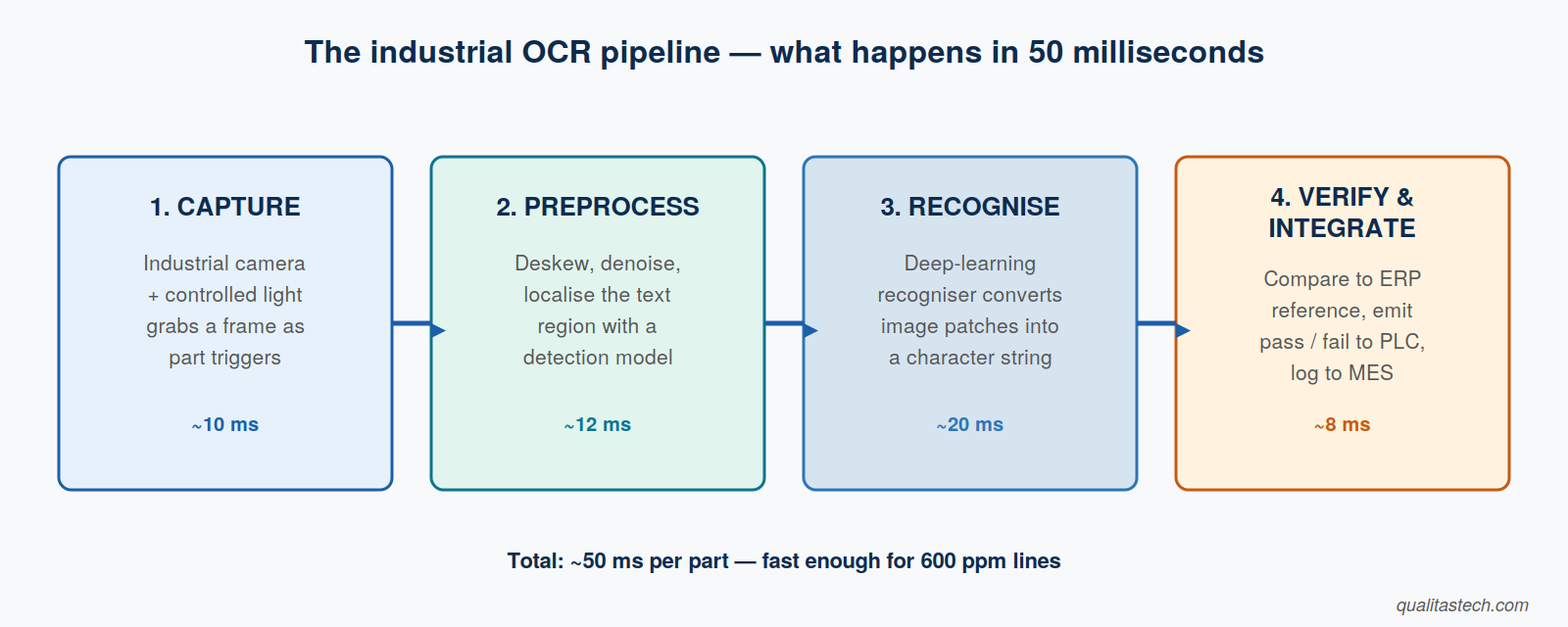
Speed compounds the problem. A pharma blister line runs 80 to 300 packs per minute; a liquid-fill bottling line clears 600 bottles per minute. The camera has milliseconds to capture, the OCR engine has milliseconds to read, and the reject mechanism has milliseconds to act. Most line operators end up with a backlog of rejects flagged “unreadable” that a human can read in seconds.
How AI and deep learning change OCR accuracy
Deep learning rewrote the OCR playbook. Modern industrial OCR engines train on tens of thousands of real factory images — including the messy, smudged, partially-occluded examples that used to trip up rule-based engines — and learn the visual signature of each character under field conditions.
The shift produces three measurable changes:
| Dimension | Rule-based OCR | AI-trained OCR |
| Accuracy on poor-quality print | ~70% | 99%+ |
| Embossed / etched characters | Frequent fails | Reliable with right lighting |
| New SKU onboarding | Re-engineer template | Add samples, retrain |
| Behaviour over time | Degrades | Self-improves shift to shift |
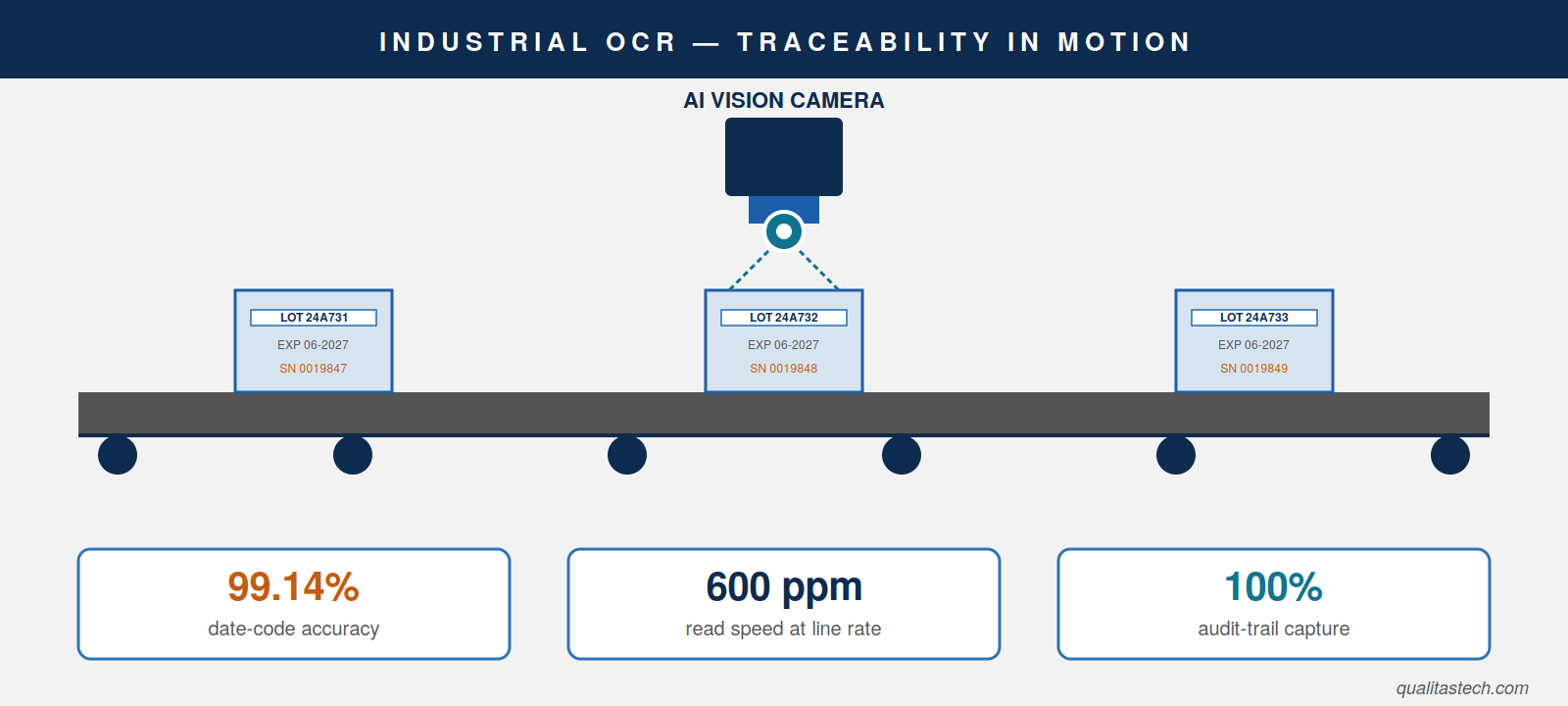
The numbers from real deployments back this up. On an Indian tobacco line, an AI-powered OCR for cigarette packet data extraction case study documents 99.14% accuracy on date codes and 95.66% on serial numbers across the full range of print quality the line produces. On gas cylinder OCR inspection on a real production line, the same approach achieves 99% accuracy on date codes and tare weights stamped into curved metal under poor lighting — work that rule-based OCR could not complete reliably.
99.14%
date-code accuracy on a real production line — what AI-trained industrial OCR delivers when the training set includes the messy reality of the factory floor, not the polished samples in a vendor demo.
Traceability use cases — pharma, FMCG, and automotive
The same engine reads different jobs across industries:
- Pharma. India’s CDSCO enforces barcoded traceability for exported formulations, and global GS1 serialisation standards govern downstream supply chains. A label print inspection AI camera reads the lot, manufacturing date, expiry, and unique identifier on each blister or carton, verifies them against master data, and stamps a pass-or-fail flag into the PLC. Pharma label inspection that catches lot-code mismatches before they ship can prevent recalls that cost a single batch its entire revenue.
- FMCG. Volume is the challenge — a bottling or pouching line may print 50,000 to 150,000 best-before dates a day. A label check vision inspection system catches the failures (partial dates, ghosted dates, dates printed over wrinkled labels) that human end-of-line checkers inevitably miss. The detailed architecture is in our AI-powered label print inspection app note.
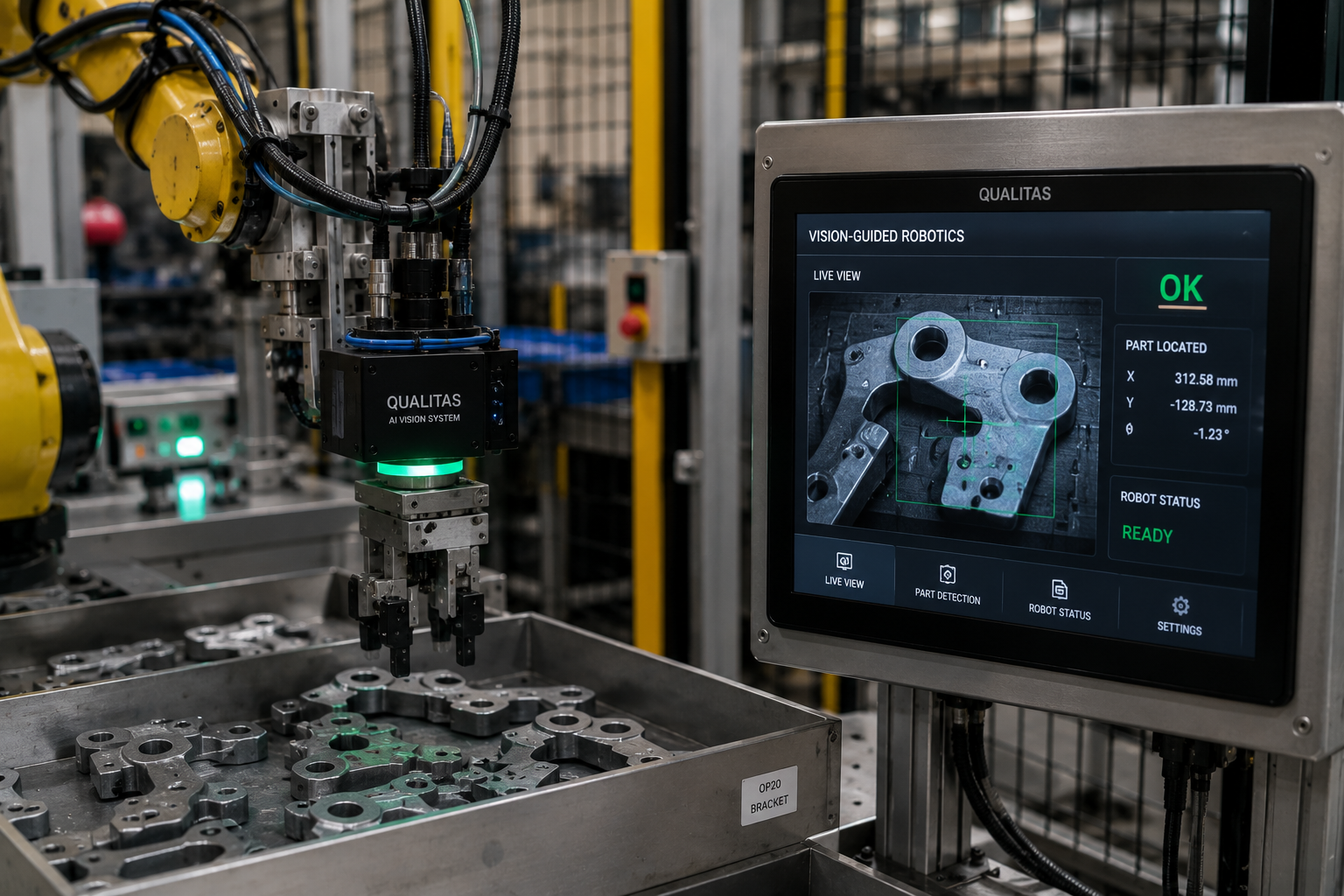
- Automotive. OCR reads stamped VINs, casting numbers on engine blocks, and serial codes on stamped panels. The character set is shorter but the surface conditions — oily metal, light reflection, embossed depth variation — are punishing. A documented example of engine character inspection deployed on an automotive line shows the kind of accuracy that survives a real assembly bay.
Across all three industries, the common thread is the audit trail. The OCR is not the product; the structured record it produces is.
Implementation tips for an industrial OCR rollout
Most failed OCR projects fail in commissioning, not in the lab. Four practical commitments make the difference between a 70% deployment and a 99% deployment:
- Start with the worst images, not the best. Vendor demos with crisp samples mean little. Collect a representative dataset on day one — clogged-print samples, smudged labels, low-contrast etches. Plan for 5,000 to 10,000 real images per character class before going live.
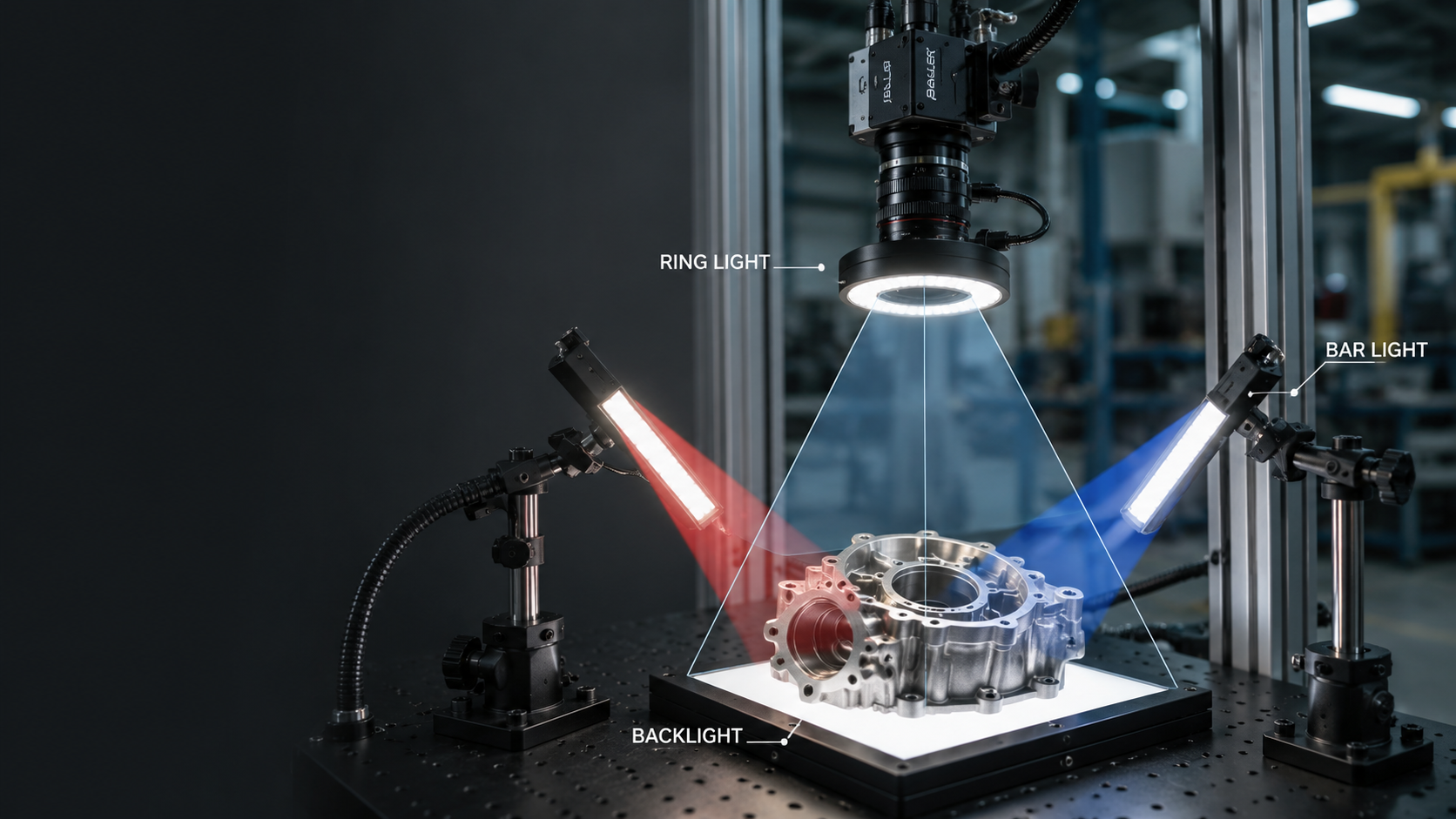
- Lock the lighting and optics. OCR accuracy is bound by image quality, not algorithm cleverness. Specify a fixed-mount industrial camera with a controlled illuminator — bar lights, diffused dome, or coaxial as the surface demands — and engineer ambient lighting changes out at install.
- Decide upstream what a “fail” means. “Did not match” can mean illegible, mismatched against ERP, or misformatted. Each requires a different downstream action: reject, rework, alert, or pause the line. Define the action plan before commissioning.
- Plan for retraining, not “set and forget”. New SKUs arrive, packaging suppliers change, ink batches drift. Choose a machine vision system with a built-in retraining workflow and assign one person on the QA team to own it.
Frequently asked questions
Is industrial OCR more reliable than barcode scanning?
OCR and barcodes complement each other. Barcodes are denser and faster to read but become unreadable when damaged. OCR reads the human-readable text — what regulators expect as the truth-of-record on the label. The strongest pipelines verify both.
Can vision OCR read laser-etched and embossed characters?
Yes, with the right lighting. Embossed and etched characters are shape-based rather than contrast-based, so they need angled lighting — coaxial or low-angle bar lights — to throw the characters into shadow. With that lighting, modern AI OCR handles them as well as printed text.
What is the difference between OCR and OCV?
OCR reads what the text says. OCV (Optical Character Verification) compares what was read to what was supposed to be printed. Most production lines need both: OCR captures the data, OCV catches the print errors before the product ships.
How does OCR data reach the ERP or MES?
Through the same digital I/O, Modbus, OPC-UA, or industrial Ethernet channel that already connects the line PLC. The OCR system emits a structured string per part — read text, pass-or-fail flag, timestamp — and the line controller forwards it to the database that owns the audit trail.
The takeaway
Industrial OCR has quietly become the data layer that keeps every recall, every audit, and every export shipment defensible. The cameras are not glamorous, but the structured records they produce are the most-cited evidence in factory traceability disputes — which is why an AI-driven OCR traceability machine vision system in India is one of the highest-leverage investments a regulated manufacturer can make.
If you are scoping the technology for the first time, our explainer on why machine vision is more accurate than manual inspection walks through the underlying mechanics with worked examples.